
Opinion & Analysis
Best Ball-Strikers (Part 1): Tommy Bolt and Moe Norman

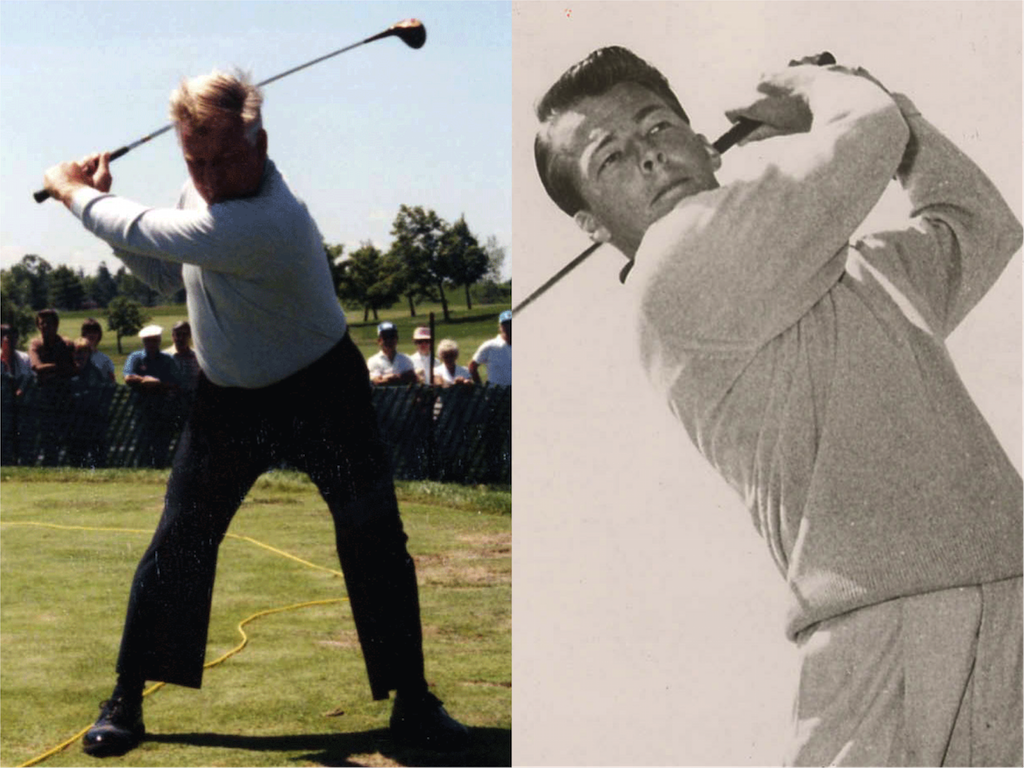
I was asked by the editorial staff of GolfWRX to write about some of the “names” I’ve played with during my 40 years in the golf industry. Initially, I declined. I was uncomfortable, because it sounded like an excuse to name drop. They told me if I wrote it they would give their review and if it didn’t sound right they wouldn’t run it.
So as I proceed, I don’t know whether this story will publish or not.
Editor’s Note: Who wouldn’t have published this? Read on.
To start, one doesn’t enter the golf equipment industry with dreams of playing a lot. I have known a few salesmen who always found time to play, and they also found jobs outside the industry. Personally speaking, for the better part of 10 years, I averaged less than 5-to-6 rounds a year. At my skill level this meant ceremonial golf, an occasional decent shot and no overall quality.
I have come up with a foursome I played with in a variety of situations over the years and they each left a lasting impression for different reasons. I’ll start with a disclaimer: I did not include Arnold Palmer, who I have played with 5-to-6 times. It’s because he is Arnold Palmer, the King of my era and my personal golf hero. I was so enthralled by the opportunity to play with him that it wasn’t really golf. All I can remember is being in his presence and that was enough.
So in alphabetical order, here it goes.
Tommy Bolt

Tommy Bolt won 15 times on the PGA Tour, including the 1958 U.S. Open.
Prior to the annual PGA Merchandise Show in Florida, my good friend Jim Achenbach of Golfweek would contact me and Bob Cantin from Ping to set up a game with Bolt at Black Diamond, a 36-hole facility in Lecanto, Fla., about 90 minutes northwest of Orlando. My weak memory would place this in the late 90’s when Bolt was older than 80.
When I flash back, I always have the same memory and that was his swing. Bolt didn’t so much as swing the club back as he placed it in a perfect position at the top. There was no unnecessary movement, just this magnificent swing that produced a shot quality I could only dream about. I remember asking him if he minded my standing behind him because I just wanted to watch every detail of that swing. He was a joy to play with, told us stories… I’ll never forget that swing.
Moe Norman
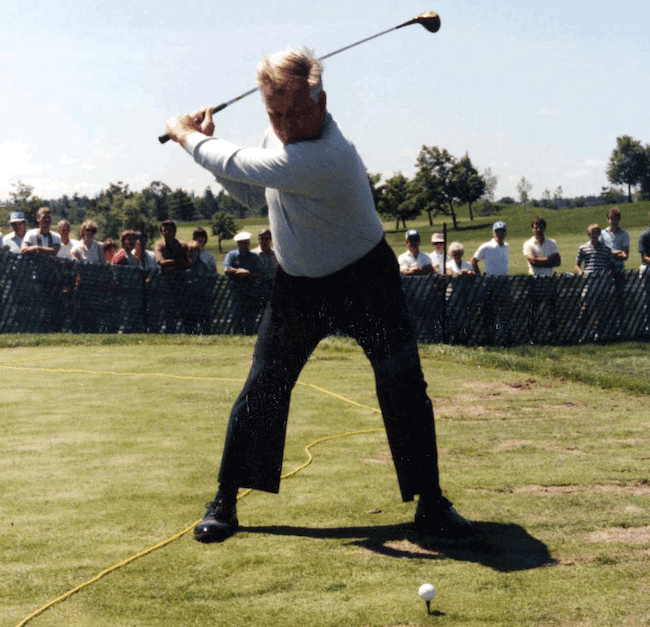
Moe Norman won 55 times on the Canadian Tour and in other Canadian golf events.
Back in the 90’s, there was a club in Titusville, Fla., called Royal Oak Golf Club and it was owned at the time by the Canadian PGA. As such, Moe had access and it became his winter headquarters. My mom lived adjacent to the 13th hole, and with Titusville being about 40 miles from Orlando I made it a point to go to the PGAM Show early (and sometimes stay) so I could hang out with her and two of my brothers who lived nearby. The driving range was a short walk from her house and there was Moe.
Moe has been described as autistic and a savant, but neither is correct. If you’re interested in his life I suggest you secure a copy of “Moe and Me” by the excellent Canadian writer Lorne Rubenstein.
I believe there are two kinds of ball strikers, related but slightly different. The first is the player on the course envisioning and hitting one shot, then moving to a completely different shot. The second is the guy on the range who hits tens, maybe hundreds of shots at a target with the same club. Obviously there is a relationship, as Moe was a great on-course player, but on the range he was otherworldly. We used to play nine holes in the late evening and he would play two balls, worst ball and break par — and he wasn’t a great putter. I say “we” played, but half the time I don’t think he realized I was there. Still, I never missed the chance.
I see his name used on the Internet as exemplifying some kind of mythical golf swing that, if emulated, would be “the answer.”
I made Moe’s clubs. If a standard swing weight is D2, his would have been F-something and the grips were jumbo plus. You see, Moe was strong and I mean freaky strong. It was as if his body was protecting the damage done in his childhood sleighing accident. He could grab you by the upper arm and with seemingly little effort take you to your knees. So for all those Moe Norman aficionados, I suggest starting with clubs four times heavier than normal and being abnormally strong.
There are a million ball-hitting stories, and I’ll give you a few.
Moe was at a different range, Jonathan’s Landing, and I happened to be there. He was hitting drivers off the deck and would announce draw or fade and how high. He always told me he played by height! Now, I’m not saying when he called for a slight draw at 40 feet it went exactly that height, but it drew and it was about twice as high as the one he called at 20 feet and this was off the deck!
When Moe hit drivers off a tee, he would literally hit a bucket and never move the tee. Like all great ball strikers, his shots had a different, quiet sound. Maybe my favorite happened one evening at Royal Oak. It was dusk and he was there alone hitting little pitches at a flag stuck in the ground (the place was not plush). I was the only other person and as he hit shots he talked to me, as he often did while hitting balls.
“I play by height,” he said. “This one 4 feet, this one 8 feet.”
He hit shots from very mediocre lies to this flagstick in the dusk. He hit maybe 30 or 40 balls and 11 hit the flag and I thought another 20 were going to. It was incredible, and I’ll never forget it.
Moe had a few great lines, and one afternoon he said one of the wisest things about practice I’ve ever heard. It was probably the mid 90’s, PGAM Show time, and I’d talked the Haney Ranch gang — all the instructors and Hank — into coming over to Titusville to watch Moe hit balls. I was the club fitter at Haney Ranch at the time.
Moe was hitting 6 irons, just one perfect shot after another, and then hit one a bit fat. He was rapid fire, so when one of the instructors, Tracy Philips, asked him about what he thought about the fat shot, it was two or three balls later. Moe stopped, took a swig of his ever present Coke and said:
“What did I think?” Moe said. “That was a bad shot. I don’t think about bad shots. I only think about good shots.”
He put down the Coke and went on with perfection.
He actually repeated himself, as was his syntax in those days, but I’ll never forget the words. How many of us get tied up analyzing our bad shots and don’t learn from the good ones.
Thanks, Moe!
Related: Best Ball-Strikers (Part 2): Lee Trevino and Tom Watson.


Club Junkie
Tour Edge Exotics mini driver review + TaylorMade Spider ZT Max first look – Club Junkie

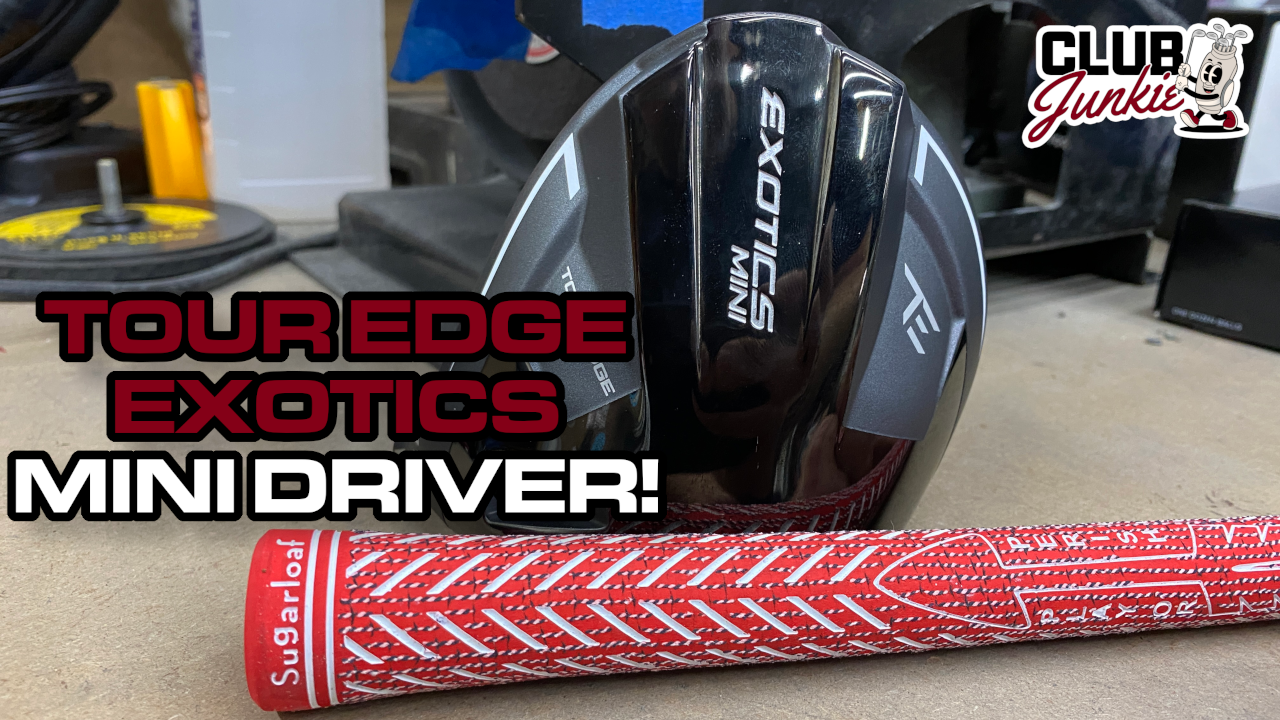
On this episode of Club Junkie, I put the new Tour Edge Exotics Mini Driver to the test and break down the performance, forgiveness, distance, and where it fits compared to a traditional driver or strong fairway wood. If you have been curious about adding a mini driver to the bag, this one is worth a look.
I also dive into the new TaylorMade Spider ZT Max putter that was recently spotted and discuss the growing zero torque putter trend. Plus, there is a closer look at the new Project X Titan Yellow shaft showing up on the PGA Tour and what makes it different from other profiles currently out there.
Opinion & Analysis
AVL: We’re talking about practice! My best tips for taking your game to the course

With the beginning of June on the horizon and courses rounding into peak condition for the season, it’s time to hone the finer skills that often get rusty over the winter. More sunlight also means more time to get out on the course and work on your game.
Whether it’s the practice green or the driving range, there’s always something to improve—whether you’re enjoying the fresh air or preparing for a weekend game or tournament. You can work on drills or freestyle around the green, and friendly competition is a great way to sharpen your skills.
While there are endless ways to get better at golf, I’m going to focus on practicing around the green. Let’s take a look at a few things to keep in mind as we head into the summer months.
Drills
From the driving range to the practice green, it’s important to incorporate drills into your routine. Years ago, I spent a weekend working on my short game with James Sieckmann. He recommended doing drill work for 5–10 minutes, then returning to your main practice.
This way, you create a balance between structured drills and real-world scenarios, so you’re not confined to “perfect” situations. For example, hitting the same three-foot putt over and over is good for repetition, but after a while, it becomes less interactive for your brain.
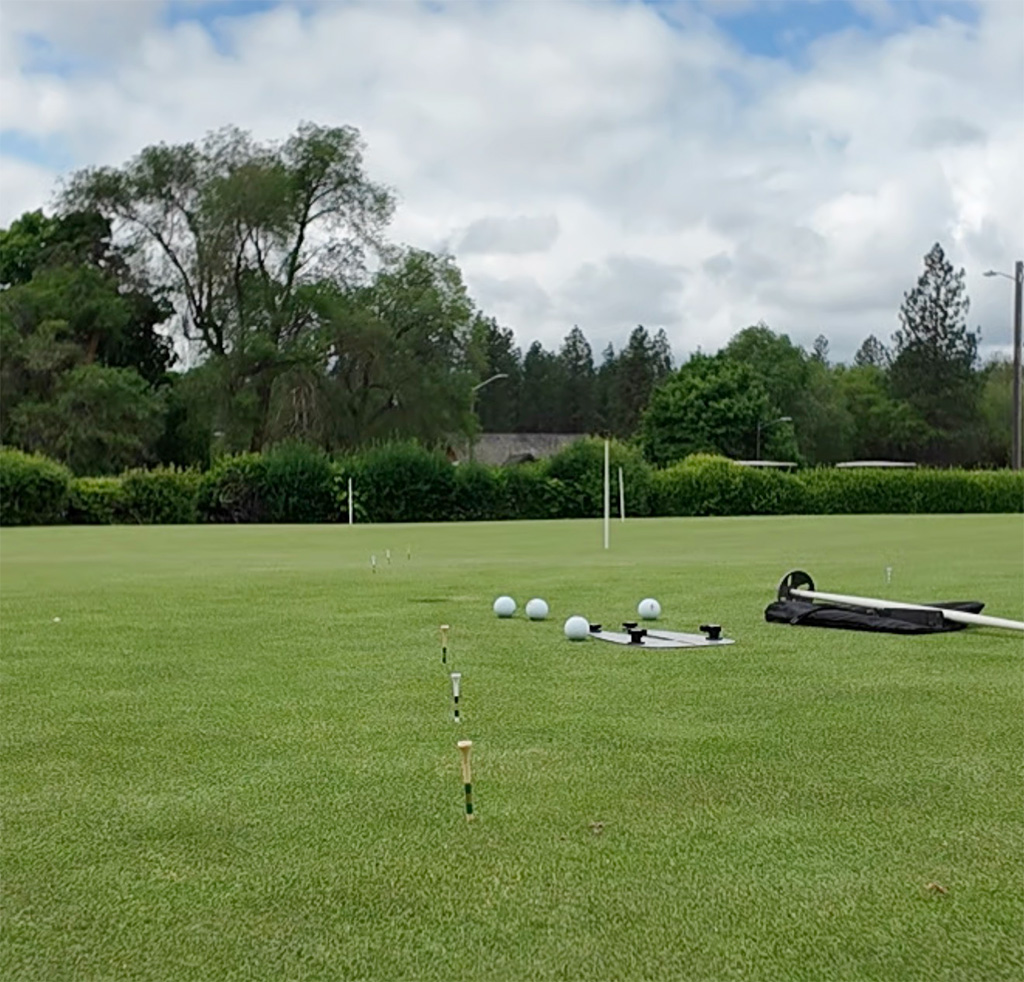
My approach is to use a putting trainer with a narrow gate for the ball to pass through, or simply place tees just outside the width of the ball. I’ll hit a series of four putts through the gate for three sets. Then, from a similar distance, I’ll hit four putts without the training aid and repeat that sequence three times.
Next, I’ll hit a number of 15–25 foot putts in a random fashion, then circle back to repeat the short putt drills with and without the training aid.
This breaks up the rhythm of hitting short putts with the training aid. When you hit the same short putts over and over, it’s easy to get into a groove—which is great for the drill, but not reflective of actual course play. While finding a rhythm is fundamental for drills, I like to introduce variation with longer putts to keep things realistic.
Game Mode
Once you’ve established a foundation with drills, it’s time to simulate on-course scenarios. This is where a few practice games come in handy.
One that I’ve been enjoying lately involves putting 10- to 15-footers with two balls. If I make the putt, great! If I miss, I pull the missed ball back a putter length. Suddenly, that little tap-in becomes a nerve-wracking three-footer—at least at first. As you get better at this game, those three- and five-footers become much more comfortable and routine.
It may sound cliché, but each shot is just what it is—it’s how we react that makes the difference. I like this game because it blends the pressure of on-course putting with the consequence of leaving yourself a much longer putt than usual.
Another game I like is one I recently learned from Brad Faxon. Place three tees in a line at four different locations around the hole: one at 3 feet, one at 6 feet, and one at 8 feet. The 3- and 6-foot putts count as par, and the 8-footer is for birdie.
This game keeps you focused on scoring and helps you get into a competitive mindset. You can even think about this putting game while you’re on the course. I just started playing it, and last week I couldn’t get better than two under par.
Competition
Competition during practice is when drills and games come to life, and you start to see results. For me, nothing beats a putting contest with a friend or two. In the right setting, these contests can become talking points for the whole season.
Match play, a game of 21, or simply seeing who can make the most one-putts (with a small prize on the line) are all great ways to simulate real on-course pressure. Recently, I played in a putting contest where one competitor made back-to-back 30- and 50-foot putts. As they say, expect your opponent to make every putt—and he nearly did. That’s impressive, and it’s something you see on the course, too: you have to stay committed to your game plan, no matter what.
When it comes to practice, it’s important to blend feedback from recent rounds with the fundamentals you want to reinforce. Drills, games, and competition—from the driving range to the putting green—form the backbone of skills you’ll rely on during actual rounds.
Finding the right balance is something we’re all working on, one practice session at a time. With the beginning of June on the horizon and courses rounding into peak condition for the season, it’s time to hone the finer skills that often get rusty over the winter. More sunlight also means more time to get out on the course and work on your game. Whether it’s the practice green or the driving range, there’s always something to improve—whether you’re enjoying the fresh air or preparing for a weekend game or tournament. You can work on drills or freestyle around the green, and friendly competition is a great way to sharpen your skills. While there are endless ways to get better at golf, I’m going to focus on practicing around the green. Let’s take a look at a few things to keep in mind as we head into the summer months.
Drills
From the driving range to the practice green, it’s important to incorporate drills into your routine. Years ago, I spent a weekend working on my short game with James Sieckmann. He recommended doing drill work for 5–10 minutes, then returning to your main practice. This way, you create a balance between structured drills and real-world scenarios, so you’re not confined to “perfect” situations. For example, hitting the same three-foot putt over and over is good for repetition, but after a while, it becomes less interactive for your brain.
My approach is to use a putting trainer with a narrow gate for the ball to pass through, or simply place tees just outside the width of the ball. I’ll hit a series of four putts through the gate for three sets. Then, from a similar distance, I’ll hit four putts without the training aid and repeat that sequence three times. Next, I’ll hit a number of 15–25 foot putts in a random fashion, then circle back to repeat the short putt drills with and without the training aid.
This breaks up the rhythm of hitting short putts with the training aid. When you hit the same short putts over and over, it’s easy to get into a groove—which is great for the drill, but not reflective of actual course play. While finding a rhythm is fundamental for drills, I like to introduce variation with longer putts to keep things realistic.
Game Mode
Once you’ve established a foundation with drills, it’s time to simulate on-course scenarios. This is where a few practice games come in handy. One that I’ve been enjoying lately involves putting 10- to 15-footers with two balls. If I make the putt, great! If I miss, I pull the missed ball back a putter length.
Suddenly, that little tap-in becomes a nerve-wracking three-footer—at least at first. As you get better at this game, those three- and five-footers become much more comfortable and routine. It may sound cliché, but each shot is just what it is—it’s how we react that makes the difference. I like this game because it blends the pressure of on-course putting with the consequence of leaving yourself a much longer putt than usual.
Another game I like is one I recently learned from Brad Faxon. Place three tees in a line at four different locations around the hole: one at 3 feet, one at 6 feet, and one at 8 feet. The 3- and 6-foot putts count as par, and the 8-footer is for birdie.
This game keeps you focused on scoring and helps you get into a competitive mindset. You can even think about this putting game while you’re on the course. I just started playing it, and last week I couldn’t get better than two under par.
Competition
Competition during practice is when drills and games come to life, and you start to see results. For me, nothing beats a putting contest with a friend or two. In the right setting, these contests can become talking points for the whole season. Match play, a game of 21, or simply seeing who can make the most one-putts (with a small prize on the line) are all great ways to simulate real on-course pressure. Recently, I played in a putting contest where one competitor made back-to-back 30- and 50-foot putts. As they say, expect your opponent to make every putt—and he nearly did. That’s impressive, and it’s something you see on the course, too: you have to stay committed to your game plan, no matter what.
When it comes to practice, it’s important to blend feedback from recent rounds with the fundamentals you want to reinforce. Drills, games, and competition—from the driving range to the putting green—form the backbone of skills you’ll rely on during actual rounds. Finding the right balance is something we’re all working on, one practice session at a time.


For Korean golfers, we always look forward to the last of the kkot-saem-chu-I for the true start of a new golf season. The term refers to a cold snap, but literally translates as “winter being jealous of the flowers beginning to bloom, thus lashing out one final time before surrendering to spring”.
A rather poetic mouthful packed into a short expression.
Koreans can be like that. Understated, yet oddly expressive at the same time. And nowhere is this more true on the golf course and in our golf bags. In fact, I suspect many Korean golfers look forward to new apparel and accessory drops more than they do actual equipment launches each year.

At this point, Korean golf fashion may exist on its own timeline. (courtesy of @seonbi_golfer)
There is ample evidence to support that suspicion. Korea is the world’s third-largest golf market behind the United States and Japan, yet its appetite for golf apparel exceeds that of both countries combined. Recent estimates suggest that Korea accounts for nearly 40 percent of the global golf apparel market, placing it among the world’s most influential golf fashion markets and punching well above its size.
Simply, we care deeply about how new golf clubs look and feel, but enjoy looking good while swinging them even more.
Golfers in the West may laugh and say that golf is played on a course, not a fashion runway. Perhaps. But what’s the harm in trying to look and feel good, if the added self-confidence can help actual performance? It certainly seems to have worked for Jason Day, who may have unlocked a new stats category: dormant strokes gained. Coincidence?

During the COVID-era, estimates placed the market near $9 billion, an astonishing figure for a single country.
As a proud member of Gen X, I’ve witnessed the highs and lows of golf fashion firsthand. The pleated trousers and wing-tipped shoes of Jack Nicklaus, the stylish plus-fours and knickers of Payne Stewart, the baggy black trousers and fitted mock-necks of Tiger Woods, and the thigh-hugging athletic tailoring of Rory McIlroy. Golf fashion, like the golf swing itself, has rarely stood still.
But nowhere have those trends shifted, evolved, and been scrutinized quite as relentlessly as in Korea. Here, golf fashion moves faster than fairway gossip, and consumers dissect brands with a level of discernment that can be both impressive and mildly terrifying. New brands are studied, judged, embraced, or dismissed with startling efficiency.
The result is a consumer base with one of the sharpest eyes for quality and authenticity anywhere in the world. It is difficult to quantify, but easy to recognize. Clean lines without trying too hard. Luxury mixed with utility. Trend awareness balanced by restraint and purpose.
It’s golf fashion shaped by one of the world’s most style-literate cities, something I like to call Seoul Sensibilities, referring to the taste level forged by a uniquely competitive environment.
And increasingly, global brands have noticed.

Many golf brands in Korea have their own flagship shops dedicated to apparel only
Titleist understood this years ago, when its apparel business in Korea took on a life of its own under new ownership and local direction. What had once been a straightforward extension of an iconic equipment giant became something sharper and more premium. By going all in on the serious Tour-player look (I couldn’t even fit into their XL sizes), Titleist struck the right chord with Korean consumers and helped its fledgling apparel business break into the mainstream. Titleist became a household name even for non-golfers who wore its caps, shirts, and windbreakers in daily life. In many ways, it proved that even heritage golf brands could carry real fashion credibility when viewed through a Korean lens.
Several years later, PXG took a page out of Titleist’s playbook and followed suit. Korean consumers helped transform the brand from one known largely for irons and loud commercials into something broader and more stylish. PXG apparel’s growth in Korea was explosive, where it found an early audience and turned the category into something more than mere logo merchandise. It is still hard to walk anywhere in Seoul without seeing its palindrome logo.
Malbon’s meteoric rise in the United States was genuine, but its ascent into a global golf lifestyle brand owes much to Korea, where it was elevated by a market already fluent in modern golf style. Korea did not simply embrace Malbon. It pressure-tested the concept, refined its appeal, and helped push it into the global spotlight.
As such, new brands may arrive from abroad, but more often than not, their sharpest evolution happens here. If a brand can earn credibility in Seoul, it’s deemed to have passed one of the toughest style audits in the game.
That is why the next meaningful chapter may not come from outside, but from a Korean brand moving in the opposite direction, carrying those Seoul Sensibilities outward as K-pop once did.

Play young Stay dope.
From Seoul, With Intent
Khalhon is a label that feels less like a trend-chasing newcomer and more like the product of a market that has already seen everything. Golfers here have long been surrounded by luxury logos, technical fabrics, and tour uniforms disguised as lifestyle wear and vice-versa. In other words, novelty alone rarely lasts here, and the Koreans seems to understand that instinctively.
Its style language leans into clean silhouettes, relaxed but tailored proportions, muted palettes, and premium materials that speak quietly but confidently. There is a modern city aesthetic running through it all, with strong layering pieces, thoughtful textures, and subtle branding that suggests sophistication rather than demanding attention.

“Built for the course. Designed beyond it.”
Most importantly, the garments seem designed to blur the line between golfwear and everyday style. Shirts, trousers, knitwear, and outer layers move comfortably between a game of screen golf, a lunch reservation, an airport gate, or an afternoon coffee in Gangnam with friends.
It raises the question of whether this is golfwear that happens to look good off the course, or everyday clothing that performs beautifully on the fairways.
Personally, I have long appreciated Nike Golf for its clean, athletic modernization of golf attire. It also has the useful side effect of making me look like a more serious golfer than I probably am. But off the course, there are times when being instantly identified as the golf guy in a crowd of non-golfers can feel a touch self-conscious.

“Built for the course. Designed beyond it.”
That is part of what drew me to Khalhon, which seemed to blend golf and everyday wear naturally. While some of the outfits may be slightly beyond my personal confidence level, the brand also offers tasteful options for older guys like me who still want to express a little personality without regretting the decision later.
These are not simply flashy outfits worn on the course and then banished to the closet until the next tee time. They work surprisingly well off the course too, and I suspect many of the pieces will still look right a couple of years from now, which would certainly be kinder to my wallet than most golf fashion trends tend to be.
And perhaps that broader lifestyle positioning also helps explain why someone like Sean Wotherspoon would find Khalhon creatively interesting in the first place.

“Built for the course. Designed beyond it.”
“Korea is not only one of the most fashion-forward golf markets in the world, but one of the most fashion-forward markets globally. Korea is ahead, and I love to watch and try to catch up.” – Sean Wotherspoon, Creative Director at Khalhon
Seoul and Beyond
If Khalhon’s rise says something about where Korean golf fashion is today, its relationship with Sean Wotherspoon says even more about where it is heading.
For readers less familiar with Sean Wotherspoon, his arrival at Khalhon is not some routine celebrity endorsement or influencer collaboration. In design and streetwear circles, Wotherspoon is regarded as one of the more influential creative voices of his generation, particularly when it comes to blending nostalgia, storytelling, and contemporary culture into products that people can connect with.
He first gained widespread attention through his now-famous Nike sneaker collaborations, where his vintage-inspired designs and instinct for color helped turn him into one of the defining artists of the late-2010s sneaker era. His work gradually expanded beyond footwear into apparel, automotive collaborations, collectibles, and broader lifestyle design.
Modern golf style now extends well beyond the fairways, where performance and functionality are largely expected by default. And while plenty of brands already make technically competent golfwear, Khalhon seems more focused on designing clothes people would genuinely want to wear even after the round ends.
And when guys at Wotherspoon’s level show genuine interest in working with a Korean golf brand as its new Creative Director, fashion circles tend to sit up and pay attention. There’s already a huge buzz among the fashion-conscious here about upcoming collabs with iconic sports stars and brands.

“My creative direction for Khalhon is disruptive, colorful, nostalgic, and modern. My goal is to blend these avenues seamlessly within each collection.” – Sean Wotherspoon
In chatting with Sean, what stood out most to me was how genuinely energized he sounded about the project itself. Despite having already worked across and countless other creative spaces, he described golf as a completely fresh category for him, saying that Khalhon “will be an amazing vehicle for my design work.”
At the same time, his enthusiasm seemed tied just as much to Korea itself. He spoke openly about admiring Korea’s fashion culture while repeatedly insisting he is still a terrible golfer.
There was something oddly refreshing about that humility. Rather than sounding like a celebrity parachuting into golf simply because the category suddenly became fashionable, Sean sounded genuinely curious about what Korea might do with the category next.
And perhaps that is what makes Khalhon feel interesting right now. The brand feels less like a trend-chaser and more like the natural result of a market now confident enough to export its own point of view.
For years, global brands came to Korea to sharpen their image against one of the most discerning audiences anywhere. Now, a Korean label appears ready to send those Seoul Sensibilities outward instead.
Which brings us back to kkot-saem-chu-i.
That final cold snap before spring always arrives with a reminder that seasons are changing, whether we notice it immediately or not. Golf fashion feels a little like that right now as well, as the old boundaries between sport, streetwear, luxury, and everyday style continue to soften.
And somewhere in Seoul, a Korean golf label already seems prepared for whatever season comes next. I just hope they have everything in my size.

Aaron Rai’s winning WITB: 2026 PGA Championship

Russell Henley’s winning WITB: 2026 Charles Schwab Challenge

Photos from the 2026 CJ Cup Byron Nelson

CJ Cup Byron Nelson Tour Report: Koepka and Kim’s newest putters finally get hot

Charles Schwab Challenge Tour Report: MacIntyre, Åberg and Spaun all switch putters, TaylorMade launches new Spider

Details on J.J. Spaun’s surprise putter switch

GolfWRX Launch Report: 2026 Titleist GTS drivers

Photos from the 2026 Charles Schwab Challenge

PGA Championship Tour Report: Fitzpatrick, Koepka among big-name putter switches for Aronimink

Photos from the ShopRite LPGA


Maria Torres WITB 2026 (June)
Driver: Ping G440 LST (9 degrees) Shaft: Accra TourZ Green 5-M4 3-wood: Ping G440 Max (15 degrees) Shaft: Accra TourZ Green 6-M4 5-wood: Ping G440...


Eric Cole WITB 2026 (June)
Driver: PXG Lightning Tour Max (9 degrees) Shaft: Project X Titan Yellow 70 TX 3-wood: TaylorMade Qi4D (15 degrees) Shaft:...


Si Woo Kim WITB 2026 (May)
Driver: Callaway Quantum Triple Diamond (8.5 degrees) Shaft: Fujikura Ventus Black 6 X Mini driver: Callaway Paradym Ai Smoke Mini...


Wyndham Clark’s winning WITB: 2026 CJ Cup Byron Nelson
Driver: TaylorMade Qi4D (10.5 degrees) Shaft: Project X Titan Yellow 60 TX 3-wood: TaylorMade Qi4D Tour (15 degrees) Shaft: Project...


Brian
Mar 16, 2015 at 6:47 pm
I remember following the final group, which included Moe, at the 1977 or 1978 (can’t remember which, it was a long time ago) Quebec Open. On one of the final holes, a par 4 or 5, there was a lengthy wait for the landing area to clear and the 3 players in the final group were just standing on the tee, chatting, the spectators milling about and waiting for play to begin.
While the players were waiting on the tee, Moe started to bounce his ball off his driver, and chatting. Bounce, bounce, bounce… I think they must have waited 5 minutes, Moe just chatting away, and bounce, bounce bouncing his ball off the face of his driver (for those of you who remember, the old tiny, persimmon type). At one point, everyone, players and spectators alike, just went silent watching Moe, seemingly in his own world, just chatting away, and bounce, bounce, bouncing the ball off the face of his driver – and he was the only person of the thousand or so standing on that tee that was seemingly not even aware of what he was doing. he was not paying attention at all, just reflex and subconscious controlling his actions.
I’ve been playing golf for 50 years, have been inside the ropes at multiple PGA Tour events and a President’s Cup, but I’ve never seen anything like that. Totally otherworldly…
Tony Cassimatis
Mar 5, 2015 at 1:57 pm
Dear Mr Adams,
Great article on Moe Norman. A friend of mine told me about the swing back in 2008 when I was about to give away golf. The swing resurrected my game and I fully believe in the Physics of the swing. I also don’t suffer from bad back problems now. I may not get distance like conventional but I sure as heck have had a massive reduction in bad shots and an increase in more accurate shots. So here’s to Moe a true golfing legend….
Jeff
Mar 1, 2015 at 6:03 pm
Thanks Mr. Adams. The only folks who didn’t love reading that story have spent money on Todd Graves Moe Norman scams. Great story, fascinating.
Larry
Mar 1, 2015 at 10:49 pm
I loved the story and the Todd Graves scam has me playing the best golf ever….once you under stand what the Graves is giving you the fairways and greens are all yours…just learn to putt. In 25 years never found an eaiser way to play golf.
Barney Adams
Mar 1, 2015 at 11:54 pm
I do not know Todd Graves or his teaching methods. The story was strictly on my experience with Moe and absolutely he was unnaturally strong and played heavy clubs when I made them. I was not a fan of Natural Golf but as I understand that isn’t the Graves program. Just a general FYI.
Randel
Mar 7, 2015 at 1:05 am
Been doing the Graves Moe Norman type swing years now….11 handicap 59 years of age..it works so well for us older guys that have a hard time moving all the parts at the right time in the normal golf swing… distance is no problem you just move your arms faster and us older guys can still do that..
Jw
Mar 1, 2015 at 1:08 am
this is the type of article that keeps me checking back on golfwrx on occasion
Mini Smizzle
Feb 27, 2015 at 8:15 pm
There’s a guy in my neighborhood named moe norman
He don’t look like goldmember tho
Jay
Feb 27, 2015 at 3:22 am
Barney, I’ve read the book you mentioned about Moe and have taken single plain golf lessons at Graves Golf Academy. The book and the lessons were a wonderful experience. While I was at Graves Academy taking lessons from Todd Graves, he (Todd) would tell stories about Moe. I could tell that Todd really liked Moe and above all, respected him. I’ve never met Moe personally, but, wish that I’d had the opportunity. Your article is another wonderful story about Moe that I enjoyed very much. Everything that I’ve ever heard about Moe from people that have met him and spend time with him have all be positive. Thanks Barney for your story. I would love to hear/read more about your experiences with Moe.
CairnsRock
Feb 26, 2015 at 11:05 pm
I asked Moe why he used such huge oversized grips?
Answer…Control, control.
He says everything twice.
Trevino Smizzle
Feb 26, 2015 at 7:18 pm
I’ll say this about moe…he proves what I believe in
It’s not got to be pretty, it’s got to be repeatable
I’ll take the guys that win over the guys that should win anyday. I heard Butch Harmon on TV say “a good shot comes from a good swing, I don’t care what it looks like”
Tiger Smizzle
Feb 26, 2015 at 7:12 pm
Moe could activate his glutes better than any other golfer ever
Moe Smizzle
Feb 26, 2015 at 7:11 pm
The real key to hitting it straight is to just top it real bad. Catch it as low on the face as possible. It’ll only go about 40 yards at best but it’ll be the straightest ball you ever see
Barney Smizzle
Feb 26, 2015 at 7:05 pm
I remeber moe telling me one time..
Popularity is like toothpaste, it’s overrated
Eli Yates
Feb 27, 2015 at 1:57 pm
I see what you did there.
Barney Smizzle
Feb 26, 2015 at 7:04 pm
I remember moe telling me one time…
Popularity is like toothpaste, it’s overrated
Greg V
Feb 26, 2015 at 11:48 am
Tom,
Before the 1956 Masters, Moe had just come down from Canada where he had been setting pins at a bowling alley all winter. He had hardly enough time to practice, and setting pins is tough on the back.
I am not saying that Moe was the best ball-striker of all time; there were some other guys who were really great in their day like Hogan and Byron Nelson. But one would have to agree that Moe was very accomplished.
Roosterredneck
Feb 26, 2015 at 8:34 am
I liked the story.Consider that Moe slept in sand traps at times because he had no money. Dare say how well we could play after sleeping in a sand trap.. I would like to read more about Moe.
RG
Feb 26, 2015 at 2:27 am
Great article Barney. You are sorely missed running you company, but at least I got some good reads out of it. Keep up the good work!
RG
Feb 26, 2015 at 2:25 am
Takes one to know one.
Robert
Feb 26, 2015 at 1:18 am
In 1992 I was 16 and worked at a golf course in Saskatchewan , Canada. Moe was doing a tour at the time, doing exhibitions across the country, and he did our course one evening passing through. I was fortunate to meet him and had the pleasure of picking the range that night after his deal.
I’ll never forget he hit every club in his bag to the 150 yard sign, every shot from every club was all over it. There was 50-100 balls in a 10′ radius around that sign when I was shagging that evening. Incredible and something you never forget.
Mark H
Feb 26, 2015 at 12:12 am
Thanks for the great article, Barney!
Sad to read so many mean spirited comments about Moe, but I guess everybody is entitled to their own opinion. In the year 2015, such a high functioning person who suffers from aspergers would be celebrated, not relegated as a “weirdo”. As far as Sam Snead “getting in to Moe’s head so bad”… They played golf together for decades after that, and Snead openly referred to Moe as the best ball striker in the world.
Ask Lee Trevino about Moe.
Why did Tour pros line up on the driving range to watch Moe hit balls?
Anyway, Those who know don’t need an explanation, those who don’t know will always be skeptical
jon
Feb 25, 2015 at 11:13 pm
that is a great story Barney!! Thank you for sharing. Great story telling. I have sent this to a few buddies and that rarely happens.
Barney Adams
Feb 25, 2015 at 11:39 pm
To Robby Wille above; I wrote one The Wow Factor which was the story of Adams Golf. I’m mulling doing another one I’m not a professional writer ( wrote the first one no ghost involved) it’s difficult and I’m old and lazy
Christian
Feb 25, 2015 at 7:15 pm
So if Moe was not autistic, then what was wrong with him? He obviously was mentally ill or retarded then? Not brushing you teeth, the constant ego-tripping talking?
Barney Adams
Feb 27, 2015 at 12:47 am
Best to read Moe and Me for the answer. In 1995 Wally Uilhein CEO of Titleist put Moe on staff ( no strings) 5k a month for life Really a class move and testimony to how highly regarded Moe was in the industry.
Ken
Feb 25, 2015 at 7:08 pm
That was an enjoyable read. Thank you, Barney.
Ritch
Feb 25, 2015 at 6:44 pm
I grew up in Michigan across the river from Canada. I played a lot of golf in Canada and during the sixties and early seventies heard many stories about his “odd swing” and unerring accuracy. In later life, I read mores stories of his “eccentricities”. I never had the chance to see him play. As I recall, Titleist put him on staff in his last years and paid him a monthly stipend to help him make expenses. I thought that was a nice gesture.
Barney Adams
Feb 27, 2015 at 12:23 am
Wally Uihlein the President of Titleist put Moe on staff 5 k/ mo in 1995 No Strings of any kind Moe had played Titleist balls for years . Purely a class move and testimony to how highly regarded Moe was within the industry.
barney adams
Feb 25, 2015 at 6:04 pm
I started to take off on the anti Moe comments and then figured why bother. I repeat; if you are really interested read Moe and Me.
farmer
Feb 25, 2015 at 4:15 pm
Liked the article. I remember back in the day, Tommy Bolt was judged to have the best swing in the game.
Steve
Feb 25, 2015 at 3:53 pm
I love moe. Caddy tells Moe that the hole is just a driver- wedge. Moe hits wedge off the tee, driver from fairway makes birdie.
Tom
Feb 25, 2015 at 3:03 pm
At the 1956 Masters, Snead got into Moe’s head so bad, Norman never set foot on US soil again, competitively. He can ‘supposedly’ hit all the great balls he wants on the range (as a professional who can’t do that – seen tiger right?) but if you can’t even compete with guys who are supposed to be your contemporaries who cares? I’ve seen the video(s) where Moe’s hitting all these shots but I’m thinking “who gives a crap”? seriously… if i have 40 years where all i do is sit on the range, live in my car, forget to brush my teeth, etc., and hit balls all day long, then go to florida for the winter months, i had better be able to hit a golf ball. that’s what he did… Snead, and all the others, beat the pants off of Norman. The current day hack looks to youtube and thinks he’s some demigod? like he knew something they could learn from? no thanks.
lance
Feb 25, 2015 at 3:53 pm
Moe Norman: 55 Canadian Pga wins, 17 holes in one, 33 course records and 3 59’s. Snead said he was the greatest ballstriker ever! The current day youtube hack like yourself isn’t smart enough to see the perfect biomechanics of Moe’s swing. The modern swing has legs pushing up and torso moving down to be able to compensate for the distance from the ball. BACK PROBLEMS see Tiger. Being farther away from the ball allows the hips to stabilize the swing so the torso can stay down and through the shot. Lesson learned Tom now go make your game better learning from Moe’s perfect swing.
Tom
Feb 25, 2015 at 4:01 pm
hey lance-i-baby… look at snead’s record, then look at norman’s. done. who cares about tiger… norman is a “what could hvae been” story where snead is a “look at what he did” story. go back to your canadian dreams.
Jay
Feb 25, 2015 at 5:52 pm
Tom – if you knew anything about golf history then you would know why Moe had the record he did. His record, or lack of, still does not diminish his skills.
Rich
Feb 25, 2015 at 7:43 pm
Wow, who got out of the wrong side of bed this morning? You must remember to take your happy pills before commenting.
Philip
Feb 25, 2015 at 10:34 pm
Snead tried to give Moe a valid tip for long irons. Unfortunately he could never of expected Moe to try and ingrain the change that day and end up blistering his hands raw after practicing into the dark night. He would have expected Moe to consider the tip after the Master’s not make a swing change on the spot and get stuck between two swings.
In addition, Moe did play again a second time at the Masters and for a little while on the PGA tour so you may want to validate your information first.
Greg V
Feb 25, 2015 at 2:40 pm
CJ Bell – smooth.
Thanks.
Rob
Feb 25, 2015 at 1:45 pm
Moe was one of a kind for sure. “Maybe I should take up fishing.” is the thought that goes through most peoples heads if they watched him hit balls. It was a completely different level.
Jeffrey
Feb 25, 2015 at 1:24 pm
Hey Barney how did you get Moe’s club that heavy on the swing weight scale? If Moe had fat grips (which is widely known), it would be ESPECIALLY difficult to get clubs that heavy! How did you do it?? Thank you for your article –
barney adams
Feb 25, 2015 at 6:01 pm
lead tape and lead powder after I had the supplier set aside the heaviest heads he could find , the out of spec stuff.
Barney Adams
Feb 25, 2015 at 11:36 pm
Full disclosure I never put them on the SW scale just got them to where Moe was happy. I do remember thinking ” I could never sell clubs like these”
b-wall
Jun 15, 2015 at 3:20 pm
Mr. Adams,
There seems to have been an ongoing debate for years if Moe used single length clubs for his irons in his major playing days. When you built clubs for Moe, were they all one standard lie angle to promote this, or was the single length clubs just a myth?
J.R.
Feb 25, 2015 at 12:59 pm
Lorne Rubenstein’s “Moe and Me” is really a great read. I also have the audible version. I loved the story of Moe hitting full iron shots off the Practice Green at Augusta National and freaking out members. Picking them clean and leaving no blemish on the greens. It makes me smile every time. First quote that comes to mind is. Question to Moe at clinic – “Moe, can you talk a little about hitting draws or fades?” Moe’s response – “Yeah, I can hit those shots, but why would I? I can hit it straight.”
It went something like that.
Here’s a video of Moe hitting to a pin from about 70yds or so.
https://www.youtube.com/watch?v=IHmq4xhS_bI
MHendon
Feb 26, 2015 at 12:43 am
Watched the video, no doubt that’s good ball striking but it’s not that impressive considering he had quite the back stop behind the pin that kept bringing his long shots back to the pin.
Rich
Feb 26, 2015 at 4:16 am
Really? Let’s see your video if it’s not that impressive.
Scott
Feb 25, 2015 at 12:08 pm
Thanks Barney for the article. I love hearing stories about Moe.
Not to derail the article, but I will, like some posters. I have played single axis for over 20 years now and am a low single digit handicap. I do not think that you need to be freakishly strong to swing single axis. I think that Moe’s swing, or parts of it, would work for all golfers. For example, Tiger Woods was convinced to change the placement of his left hand by Hank Haney, based on Moe. When you break down the few differences between single axis and the conventional swing there is very little to argue about. Most people think that single axis has to look like a 70 year old Moe. There are a few places that you can check out the Moe of his 20s and 30s. You would be hard pressed to find differences in his swing vs. a conventional swing.
barney adams
Feb 25, 2015 at 6:08 pm
actually I agree here when I first saw film of early Moe I saw a great looking swing.
Barney Adams
Feb 25, 2015 at 8:59 pm
To comment further I was aiming at Kukyendall and Natural Golf which I felt did Moe a disservice.
Scott
Feb 26, 2015 at 5:52 pm
Unfortunately, you are right. They also did single axis a disservice. However, I guess that we can thank Jack for increasing Moe’s popularity.
Tommy
Feb 25, 2015 at 11:52 am
Great insight to your treasury of experiences, Mr Adams. Please don’t deprive us of more.
Don M
Feb 25, 2015 at 11:23 am
Loved the article! I am a big fan of Moe. His swing works for amateurs, especially those who struggle with inconsistency and big misses. If you have more good stories about Moe, please write a Part 2.
Larry
Feb 25, 2015 at 11:06 am
I switched to the “Moe type swing” just used the Graves DVD’s for about a month then took a lesson form one of the “Graves Golf” guys, which was very key as I got over “Moeish” just whatching the DVDs. This action works excellent for me (Over 65) and I now hit my driver in play and for the first time ever I can hit a hybrid without hooking it off the course. One note if you try and learn this type swing use a grass range for irons.
CJ Bell
Feb 25, 2015 at 11:01 am
Greg: https://www.youtube.com/watch?v=htgZt9wLQHQ
Greg V
Feb 25, 2015 at 10:41 am
Great article! Thanks for sharing some memories.
Now, if only I could find a video of Tommy Bolt. I actually had the pleasure of saying hello to him one time in an elevator at Pinehurst. Fortunately, I recognized him from pictures.