
Videos
Ask the Experts: What’s the difference between graphite and steel iron shafts?

Fujikura Tour fitter Marshall Thompson explains the difference between graphite and steel iron shafts, and why one may be better than the other for your game. Check out the full video below.
More “Ask the Experts” videos:



Russell made a massive charge on the last 3 holes of the 2026 Charles Schwab Challenge this weekend to force a playoff with Eric Cole. Henley drained another putt on the first playoff hole to win his 6th PGA Tour event! While he is a Titleist staff member, his WITB is far from a simple blend of the latest gear. He mixes brand new with some very old clubs in order to play his best.
Driver: Titleist TSi3 (10 degrees)
Shaft: Project X HZRDUS Smoke Black 70 6.5 TX
3-wood: Titleist TS3 (16.5 degrees)
Shaft: Project X HZRDUS Smoke Black 80 TX
7-wood: Titleist GTS3 (21 degrees)
Shaft: Project X Denali Black 80 TX
Irons: Titleist T250 (4), Titleist T100 (5-9)
Shafts: True Temper Dynamic Gold AMT (4-6)
True Temper Dynamic Gold Tour Issue S400 (7-9)
Wedges: Titleist Vokey Design SM11
48-10F @47
True Temper Dynamic Gold Tour Issue X100
50-08F @51
54-10S @55
60-04T
Shafts: True Temper Dynamic Gold Tour Issue S400
Putter: Scotty Cameron Phantom X5 Tour Prototype
Grips: Golf Pride Tour Velvet
Ball: Titleist Pro V1x
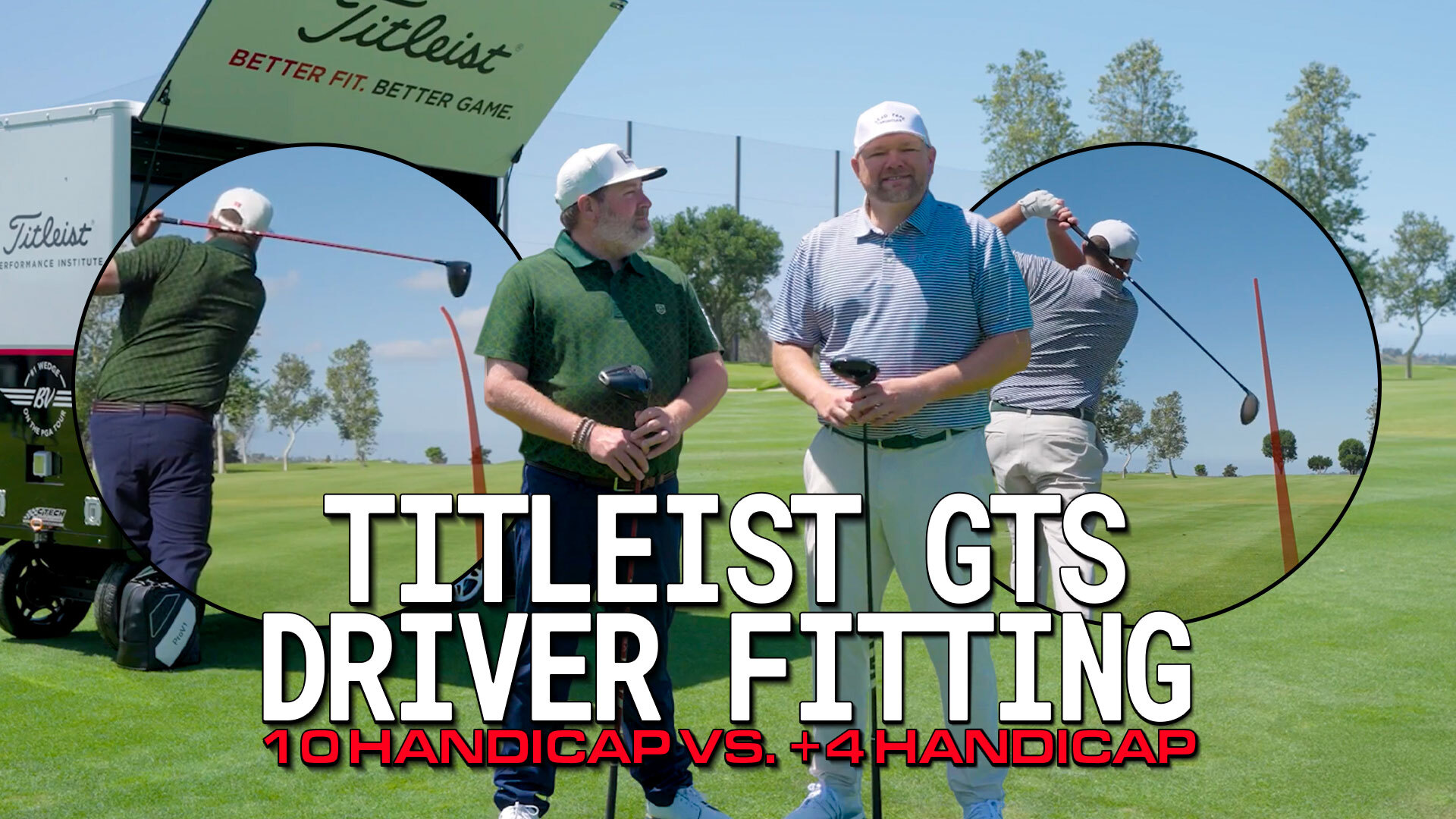
What happens when a 10 handicap and a +4 handicap go through a full driver fitting at one of the most advanced golf performance centers in the world? Brian Knudson and Andrew Von Lossow headed to the Titleist Performance Institute in Oceanside, California, to find out.
Both players go through a complete Titleist GTS driver fitting with the Titleist fitting team to see how swing speed, launch conditions, strike location, shaft profile, and head setup can completely change performance off the tee. Even though the golfers have very different games, the fitting process reveals just how important proper equipment can be for maximizing distance, tightening dispersion, and improving consistency.
You will see how Titleist fitters analyze every part of the driver setup including loft, weighting, shaft selection, and head model to build a driver specifically for each player’s swing. While the skill levels, club head speeds, and desired outcomes are different both players show how deep and versatile the new Titleist GTS driver lineup is.
Videos
Spaun’s surprise putter switch + the best wedge stamping on tour? | Inside the Ropes: Charles Schwab Challenge

Alistair Cameron takes you inside the action at the Charles Schwab Challenge in this week’s episode. Recent winner Brandt Snedeker breaks down his WITB, Neal Shipley discusses his iconic wedge stampings, the reigning U.S. Open champion, J.J. Spaun, discusses a surprise putter switch. Also featured is a look at Project X’s new Titan shafts, which debuted on tour with a bang. All this, and more!

Aaron Rai’s winning WITB: 2026 PGA Championship

Russell Henley’s winning WITB: 2026 Charles Schwab Challenge

Photos from the 2026 CJ Cup Byron Nelson

CJ Cup Byron Nelson Tour Report: Koepka and Kim’s newest putters finally get hot

Charles Schwab Challenge Tour Report: MacIntyre, Åberg and Spaun all switch putters, TaylorMade launches new Spider

Details on J.J. Spaun’s surprise putter switch

GolfWRX Launch Report: 2026 Titleist GTS drivers

Photos from the 2026 Charles Schwab Challenge

PGA Championship Tour Report: Fitzpatrick, Koepka among big-name putter switches for Aronimink

Photos from the ShopRite LPGA


Maria Torres WITB 2026 (June)
Driver: Ping G440 LST (9 degrees) Shaft: Accra TourZ Green 5-M4 3-wood: Ping G440 Max (15 degrees) Shaft: Accra TourZ Green 6-M4 5-wood: Ping G440...


Eric Cole WITB 2026 (June)
Driver: PXG Lightning Tour Max (9 degrees) Shaft: Project X Titan Yellow 70 TX 3-wood: TaylorMade Qi4D (15 degrees) Shaft:...


Si Woo Kim WITB 2026 (May)
Driver: Callaway Quantum Triple Diamond (8.5 degrees) Shaft: Fujikura Ventus Black 6 X Mini driver: Callaway Paradym Ai Smoke Mini...


Wyndham Clark’s winning WITB: 2026 CJ Cup Byron Nelson
Driver: TaylorMade Qi4D (10.5 degrees) Shaft: Project X Titan Yellow 60 TX 3-wood: TaylorMade Qi4D Tour (15 degrees) Shaft: Project...


Frank
Aug 3, 2018 at 12:26 pm
This was interesting but, as Adam noted above, not particularly helpful in terms of a comparison. In any case, as with all shafts, it’s really a matter of what suits each person’s own swing and set makeup. I am 64, 6’5″ tall, 11 handicap, and have always had accuracy issues with irons, which is the fault of my swing, not the clubs I use. That said, earlier this year I went back to steel shafts for all my irons (I play 5-SW) after testing a new, more flexible steel shaft I got through the Maltby clubmakers’ site. I haven’t had the flex tested by a fitter, but the 95 gram shafts, which they claim are “A/R flex”, do feel more flexible than any other steel shaft I’ve used in the past, and I’ve been getting much tighter shot dispersion using these shafts with Maltby STi heads than I was getting with Callaway XR’s with A-flex graphite. I gave up maybe 4-5 yards in the switch but that’s not hard to adjust to. So all of this is to say, at least in my case, the old saw about steel being generally more accurate than graphite has proven to be true.
Gerald Teigrob
Aug 3, 2018 at 11:55 am
Having benefited from playing both graphite and steel irons, I now realize that by playing stiff graphite right now, my game will make the most improvement right now. In time, I can determine when I play steel. I might still put steel in my pitching and gap wedges, but otherwise, I see no reason to rush the process! And breaking 90 for 18 holes feels pretty good, regardless of the shaft in it! I am happy that I know graphite shafts will benefit me right now…and when I move over to steel shafts in my Bio Cell irons, I can take confidence in that I know how responsive my steel irons should be!
Brian Terry
Aug 3, 2018 at 9:52 am
I’ve been playing graphite in my irons for the last 5 years after playing steel for 40 yrs. 6i SS is 90mph, so I take a healthy swipe at the ball. I’ve used Steelfiber i110CW, Matrix Program 130, Aldila RIP Tour 115 and recently UST Recoil Protos. I have found them all to perform as well or better than any steel shaft on the market. My favorite are the RIPs (sadly, no longer available) with their more penetrating ball flight and firm solid feel.
So, IMHO, anyone who claims steel is superior to graphite is just ignorant of the facts.
BT
Adam
Aug 2, 2018 at 6:42 pm
I didn’t fully understand his response to the difference between graphite and steel iron shafts. The response was too generalized and not about iron shafts. Perhaps he can add a bit more to his response.
steve
Aug 2, 2018 at 4:31 pm
Graphite shafts do not respond the same as steel shafts in final release when the shaft tip is drooping and torquing. Steel shafts have a faster dynamic response and therefore more predictable than soggy floppy graphites shafts composed of graphite fibers and plastic epoxy.
Graphite shaft makers have been struggling to create a graphite shaft tip that performs the same as steel and they have failed; still trying to embed exotic fibers into the tips.
steve
Aug 2, 2018 at 4:36 pm
Furthermore, graphite shafts from Asia are cheap to produce and there is a lot of profit margin to share with tour pros to promote them. Most golfers are gullible and think that fancy painted graphite shafts are the cat’s meow since the pros use them in drivers. The graphite shafts pros use are not off-the-shelf shafts; they are custom made and then painted for the models they are promoting.
Rascal
Aug 2, 2018 at 5:39 pm
Did ogo get banned? Welcome back!
lee
Aug 6, 2018 at 11:25 pm
I’m baaaaack … and excessive plastic epoxy is the enemy of shaft tip control in atmospheric pressure oven-cured sloppy graphite shafts.
Read about autoclave cured shafts with the excess epoxy squeezed out at high pressures in the autoclave process:
http://www.golfwrx.com/489200/a-qa-with-seven-dreamers-about-its-1200-shafts/