
Opinion & Analysis
Is equipment really to blame for the distance problem in golf?


It’s 2018, we’re more than a quarter of the way through Major Season, and there are 58 players on the PGA Tour averaging over 300 yards off the tee. Trey Mullinax is leading the PGA Tour through the Wells Fargo Championship with an average driving distance of 320 yards. Much discussion has been had about the difficulty such averages are placing on the golf courses across the country. Sewn into the fabric of the distance discussion are suggestions by current and past giants of the game to roll back the golf ball.
In a single segment on an episode of Live From The Masters, Brandel Chamblee said, “There’s a correlation from when the ProV1 was introduced and driving distance spiked,” followed a few minutes later by this: “The equipment isn’t the source of the distance, it’s the athletes.”
So which is it? Does it have to be one or the other? Is there a problem at all?
Several things of interest happened on the PGA Tour in the early 2000s, most of which were entirely driven by the single most dominant athlete of the last 30. First, we saw Tiger Woods win four consecutive majors, the first and only person to do that in the modern era of what are now considered the majors. Second, that same athlete drew enough eyeballs so that Tim Finchem could exponentially increase the prize money golfers were playing for each week. Third, but often the most overlooked, Tiger Woods ushered in fitness to the mainstream of golf. Tiger took what Gary Player and Greg Norman had preached their whole careers and amped it up like he did everything else.
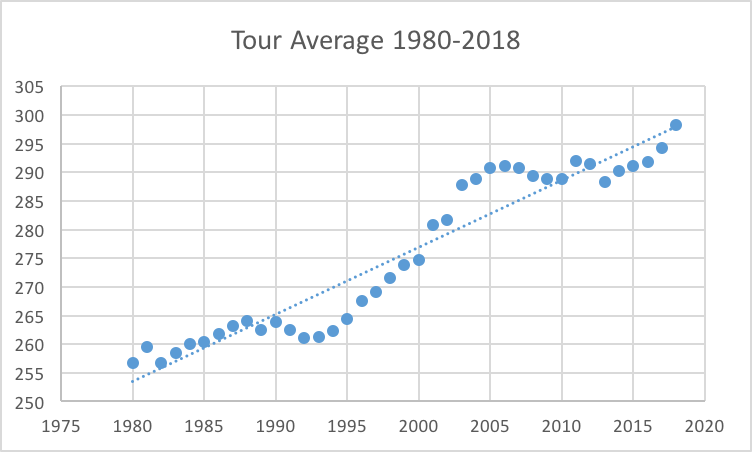
In 1980, Dan Pohl was the longest player on the PGA Tour. He averaged 274 yards off the tee with a 5-foot, 11-inch and 175-pound frame. By 2000, the average distance for all players on the PGA Tour was 274 yards. The leader of the pack that year was John Daly, who was the only man to average over 300 yards. Tiger Woods came in right behind him at 298 yards.
Analysis of the driving distance stats on the PGA Tour since 1980 show a few important statistics: Over the last 38 seasons, the average driving distance for all players on the PGA Tour has increased an average of 1.1 yards per year. When depicted on a graph, it looks like this:
The disparity between the shortest and the longest hitter on the PGA Tour has increased 0.53 yards per year, which means the longest hitters are increasing the gap between themselves and the shortest hitters. The disparity chart fluctuates considerably more than the average distance chart, but the increase from 1980 to 2018 is staggering.
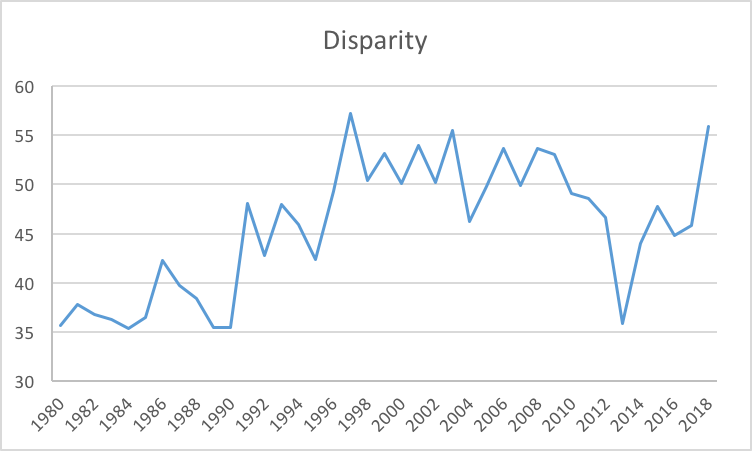
In 1980, there was 35.6 yards between Dan Pohl (longest) and Michael Brannan (shortest – driving distance 238.7 yards). In 2018, the difference between Trey Mullinax and Ken Duke is 55.9 yards. Another point to consider is that in 1980, Michael Brannan was 25. Ken Duke is currently 49 years of age.
The question has not been, “Is there a distance problem?” It’s been, “How do we solve the distance problem?” The data is clear that distance has increased — not so much at an exponential rate, but at a consistent clip over the last four decades — and also that equipment is only a fraction of the equation.
Jack Nicklaus was over-the-hill in 1986 when he won the Masters. It came completely out of nowhere. Players in past decades didn’t hit their prime until they were in their early thirties, and then it was gone by their early forties. Today, it’s routine for players to continue playing until they are over 50 on the PGA Tour. In 2017, Steve Stricker joined the PGA Tour Champions. In 2016, he averaged 278 yards off the tee on the PGA Tour. With that number, he’d have topped the charts in 1980 by nearly four yards.
If equipment was the only reason distance had increased, then the disparity between the longest and shortest hitters would have decreased. If it was all equipment, then Ken Duke should be averaging something more like 280 yards instead of 266.
There are several things at play. First and foremost, golfers are simply better athletes these days. That’s not to say that the players of yesteryear weren’t good athletes, but the best athletes on the planet forty years ago didn’t play golf; they played football and basketball and baseball. Equipment definitely helped those super athletes hit the ball straighter, but the power is organic.
The other thing to consider is that the total tournament purse for the 1980 Tour Championship was $440,000 ($1,370,833 in today’s dollars). The winner’s share for an opposite-field event, such as the one played in Puerto Rico this year, is over $1 million. Along with the fitness era, Tiger Woods ushered in the era of huge paydays for golfers. This year, the U.S. Open prize purse will be $12 milion with $2.1 million of that going to the winner. If you’re a super athlete with the skills to be a golfer, it makes good business sense to go into golf these days. That wasn’t the case four decades ago.
Sure, equipment has something to do with the distance boom, but the core of the increase is about the athletes themselves. Let’s start giving credit where credit is due.







Club Junkie
Tour Edge Exotics mini driver review + TaylorMade Spider ZT Max first look – Club Junkie

On this episode of Club Junkie, I put the new Tour Edge Exotics Mini Driver to the test and break down the performance, forgiveness, distance, and where it fits compared to a traditional driver or strong fairway wood. If you have been curious about adding a mini driver to the bag, this one is worth a look.
I also dive into the new TaylorMade Spider ZT Max putter that was recently spotted and discuss the growing zero torque putter trend. Plus, there is a closer look at the new Project X Titan Yellow shaft showing up on the PGA Tour and what makes it different from other profiles currently out there.
Opinion & Analysis
AVL: We’re talking about practice! My best tips for taking your game to the course

With the beginning of June on the horizon and courses rounding into peak condition for the season, it’s time to hone the finer skills that often get rusty over the winter. More sunlight also means more time to get out on the course and work on your game.
Whether it’s the practice green or the driving range, there’s always something to improve—whether you’re enjoying the fresh air or preparing for a weekend game or tournament. You can work on drills or freestyle around the green, and friendly competition is a great way to sharpen your skills.
While there are endless ways to get better at golf, I’m going to focus on practicing around the green. Let’s take a look at a few things to keep in mind as we head into the summer months.
Drills
From the driving range to the practice green, it’s important to incorporate drills into your routine. Years ago, I spent a weekend working on my short game with James Sieckmann. He recommended doing drill work for 5–10 minutes, then returning to your main practice.
This way, you create a balance between structured drills and real-world scenarios, so you’re not confined to “perfect” situations. For example, hitting the same three-foot putt over and over is good for repetition, but after a while, it becomes less interactive for your brain.
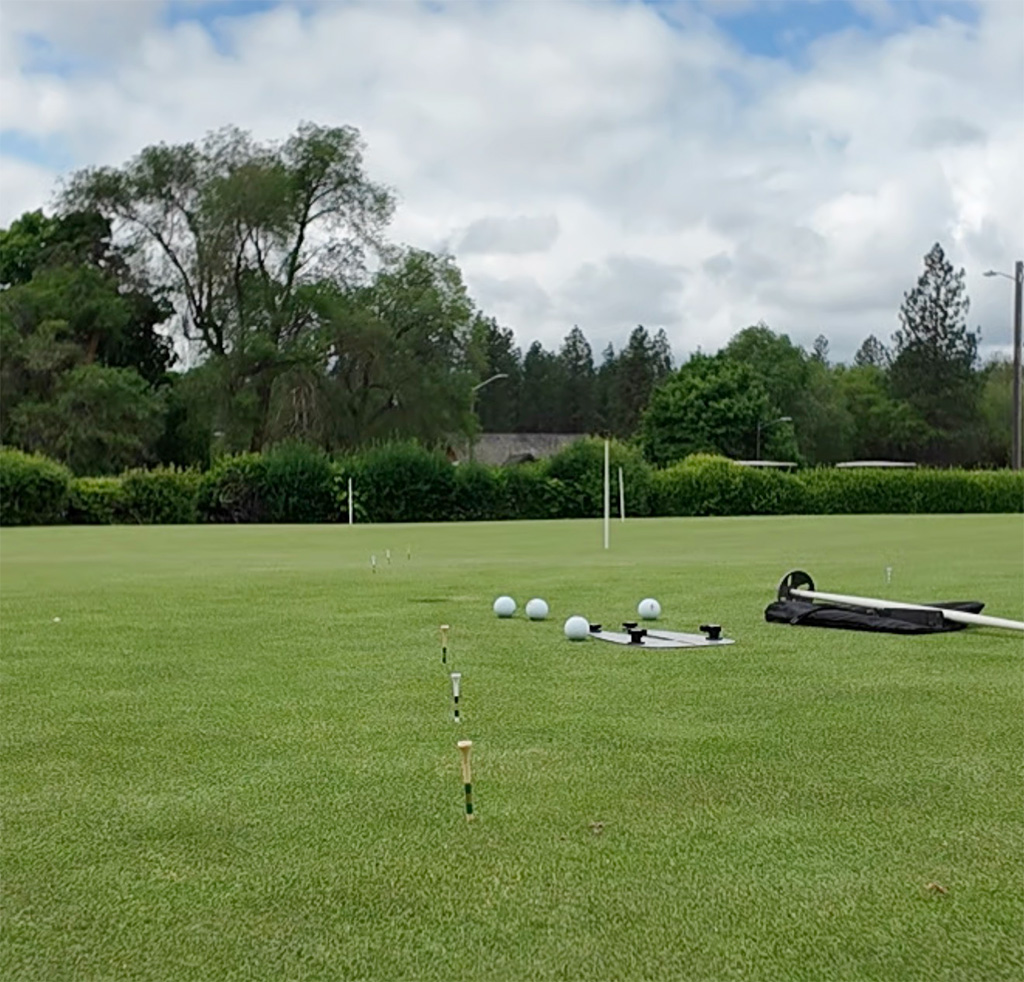
My approach is to use a putting trainer with a narrow gate for the ball to pass through, or simply place tees just outside the width of the ball. I’ll hit a series of four putts through the gate for three sets. Then, from a similar distance, I’ll hit four putts without the training aid and repeat that sequence three times.
Next, I’ll hit a number of 15–25 foot putts in a random fashion, then circle back to repeat the short putt drills with and without the training aid.
This breaks up the rhythm of hitting short putts with the training aid. When you hit the same short putts over and over, it’s easy to get into a groove—which is great for the drill, but not reflective of actual course play. While finding a rhythm is fundamental for drills, I like to introduce variation with longer putts to keep things realistic.
Game Mode
Once you’ve established a foundation with drills, it’s time to simulate on-course scenarios. This is where a few practice games come in handy.
One that I’ve been enjoying lately involves putting 10- to 15-footers with two balls. If I make the putt, great! If I miss, I pull the missed ball back a putter length. Suddenly, that little tap-in becomes a nerve-wracking three-footer—at least at first. As you get better at this game, those three- and five-footers become much more comfortable and routine.
It may sound cliché, but each shot is just what it is—it’s how we react that makes the difference. I like this game because it blends the pressure of on-course putting with the consequence of leaving yourself a much longer putt than usual.
Another game I like is one I recently learned from Brad Faxon. Place three tees in a line at four different locations around the hole: one at 3 feet, one at 6 feet, and one at 8 feet. The 3- and 6-foot putts count as par, and the 8-footer is for birdie.
This game keeps you focused on scoring and helps you get into a competitive mindset. You can even think about this putting game while you’re on the course. I just started playing it, and last week I couldn’t get better than two under par.
Competition
Competition during practice is when drills and games come to life, and you start to see results. For me, nothing beats a putting contest with a friend or two. In the right setting, these contests can become talking points for the whole season.
Match play, a game of 21, or simply seeing who can make the most one-putts (with a small prize on the line) are all great ways to simulate real on-course pressure. Recently, I played in a putting contest where one competitor made back-to-back 30- and 50-foot putts. As they say, expect your opponent to make every putt—and he nearly did. That’s impressive, and it’s something you see on the course, too: you have to stay committed to your game plan, no matter what.
When it comes to practice, it’s important to blend feedback from recent rounds with the fundamentals you want to reinforce. Drills, games, and competition—from the driving range to the putting green—form the backbone of skills you’ll rely on during actual rounds.
Finding the right balance is something we’re all working on, one practice session at a time. With the beginning of June on the horizon and courses rounding into peak condition for the season, it’s time to hone the finer skills that often get rusty over the winter. More sunlight also means more time to get out on the course and work on your game. Whether it’s the practice green or the driving range, there’s always something to improve—whether you’re enjoying the fresh air or preparing for a weekend game or tournament. You can work on drills or freestyle around the green, and friendly competition is a great way to sharpen your skills. While there are endless ways to get better at golf, I’m going to focus on practicing around the green. Let’s take a look at a few things to keep in mind as we head into the summer months.
Drills
From the driving range to the practice green, it’s important to incorporate drills into your routine. Years ago, I spent a weekend working on my short game with James Sieckmann. He recommended doing drill work for 5–10 minutes, then returning to your main practice. This way, you create a balance between structured drills and real-world scenarios, so you’re not confined to “perfect” situations. For example, hitting the same three-foot putt over and over is good for repetition, but after a while, it becomes less interactive for your brain.
My approach is to use a putting trainer with a narrow gate for the ball to pass through, or simply place tees just outside the width of the ball. I’ll hit a series of four putts through the gate for three sets. Then, from a similar distance, I’ll hit four putts without the training aid and repeat that sequence three times. Next, I’ll hit a number of 15–25 foot putts in a random fashion, then circle back to repeat the short putt drills with and without the training aid.
This breaks up the rhythm of hitting short putts with the training aid. When you hit the same short putts over and over, it’s easy to get into a groove—which is great for the drill, but not reflective of actual course play. While finding a rhythm is fundamental for drills, I like to introduce variation with longer putts to keep things realistic.
Game Mode
Once you’ve established a foundation with drills, it’s time to simulate on-course scenarios. This is where a few practice games come in handy. One that I’ve been enjoying lately involves putting 10- to 15-footers with two balls. If I make the putt, great! If I miss, I pull the missed ball back a putter length.
Suddenly, that little tap-in becomes a nerve-wracking three-footer—at least at first. As you get better at this game, those three- and five-footers become much more comfortable and routine. It may sound cliché, but each shot is just what it is—it’s how we react that makes the difference. I like this game because it blends the pressure of on-course putting with the consequence of leaving yourself a much longer putt than usual.
Another game I like is one I recently learned from Brad Faxon. Place three tees in a line at four different locations around the hole: one at 3 feet, one at 6 feet, and one at 8 feet. The 3- and 6-foot putts count as par, and the 8-footer is for birdie.
This game keeps you focused on scoring and helps you get into a competitive mindset. You can even think about this putting game while you’re on the course. I just started playing it, and last week I couldn’t get better than two under par.
Competition
Competition during practice is when drills and games come to life, and you start to see results. For me, nothing beats a putting contest with a friend or two. In the right setting, these contests can become talking points for the whole season. Match play, a game of 21, or simply seeing who can make the most one-putts (with a small prize on the line) are all great ways to simulate real on-course pressure. Recently, I played in a putting contest where one competitor made back-to-back 30- and 50-foot putts. As they say, expect your opponent to make every putt—and he nearly did. That’s impressive, and it’s something you see on the course, too: you have to stay committed to your game plan, no matter what.
When it comes to practice, it’s important to blend feedback from recent rounds with the fundamentals you want to reinforce. Drills, games, and competition—from the driving range to the putting green—form the backbone of skills you’ll rely on during actual rounds. Finding the right balance is something we’re all working on, one practice session at a time.


For Korean golfers, we always look forward to the last of the kkot-saem-chu-I for the true start of a new golf season. The term refers to a cold snap, but literally translates as “winter being jealous of the flowers beginning to bloom, thus lashing out one final time before surrendering to spring”.
A rather poetic mouthful packed into a short expression.
Koreans can be like that. Understated, yet oddly expressive at the same time. And nowhere is this more true on the golf course and in our golf bags. In fact, I suspect many Korean golfers look forward to new apparel and accessory drops more than they do actual equipment launches each year.

At this point, Korean golf fashion may exist on its own timeline. (courtesy of @seonbi_golfer)
There is ample evidence to support that suspicion. Korea is the world’s third-largest golf market behind the United States and Japan, yet its appetite for golf apparel exceeds that of both countries combined. Recent estimates suggest that Korea accounts for nearly 40 percent of the global golf apparel market, placing it among the world’s most influential golf fashion markets and punching well above its size.
Simply, we care deeply about how new golf clubs look and feel, but enjoy looking good while swinging them even more.
Golfers in the West may laugh and say that golf is played on a course, not a fashion runway. Perhaps. But what’s the harm in trying to look and feel good, if the added self-confidence can help actual performance? It certainly seems to have worked for Jason Day, who may have unlocked a new stats category: dormant strokes gained. Coincidence?

During the COVID-era, estimates placed the market near $9 billion, an astonishing figure for a single country.
As a proud member of Gen X, I’ve witnessed the highs and lows of golf fashion firsthand. The pleated trousers and wing-tipped shoes of Jack Nicklaus, the stylish plus-fours and knickers of Payne Stewart, the baggy black trousers and fitted mock-necks of Tiger Woods, and the thigh-hugging athletic tailoring of Rory McIlroy. Golf fashion, like the golf swing itself, has rarely stood still.
But nowhere have those trends shifted, evolved, and been scrutinized quite as relentlessly as in Korea. Here, golf fashion moves faster than fairway gossip, and consumers dissect brands with a level of discernment that can be both impressive and mildly terrifying. New brands are studied, judged, embraced, or dismissed with startling efficiency.
The result is a consumer base with one of the sharpest eyes for quality and authenticity anywhere in the world. It is difficult to quantify, but easy to recognize. Clean lines without trying too hard. Luxury mixed with utility. Trend awareness balanced by restraint and purpose.
It’s golf fashion shaped by one of the world’s most style-literate cities, something I like to call Seoul Sensibilities, referring to the taste level forged by a uniquely competitive environment.
And increasingly, global brands have noticed.

Many golf brands in Korea have their own flagship shops dedicated to apparel only
Titleist understood this years ago, when its apparel business in Korea took on a life of its own under new ownership and local direction. What had once been a straightforward extension of an iconic equipment giant became something sharper and more premium. By going all in on the serious Tour-player look (I couldn’t even fit into their XL sizes), Titleist struck the right chord with Korean consumers and helped its fledgling apparel business break into the mainstream. Titleist became a household name even for non-golfers who wore its caps, shirts, and windbreakers in daily life. In many ways, it proved that even heritage golf brands could carry real fashion credibility when viewed through a Korean lens.
Several years later, PXG took a page out of Titleist’s playbook and followed suit. Korean consumers helped transform the brand from one known largely for irons and loud commercials into something broader and more stylish. PXG apparel’s growth in Korea was explosive, where it found an early audience and turned the category into something more than mere logo merchandise. It is still hard to walk anywhere in Seoul without seeing its palindrome logo.
Malbon’s meteoric rise in the United States was genuine, but its ascent into a global golf lifestyle brand owes much to Korea, where it was elevated by a market already fluent in modern golf style. Korea did not simply embrace Malbon. It pressure-tested the concept, refined its appeal, and helped push it into the global spotlight.
As such, new brands may arrive from abroad, but more often than not, their sharpest evolution happens here. If a brand can earn credibility in Seoul, it’s deemed to have passed one of the toughest style audits in the game.
That is why the next meaningful chapter may not come from outside, but from a Korean brand moving in the opposite direction, carrying those Seoul Sensibilities outward as K-pop once did.

Play young Stay dope.
From Seoul, With Intent
Khalhon is a label that feels less like a trend-chasing newcomer and more like the product of a market that has already seen everything. Golfers here have long been surrounded by luxury logos, technical fabrics, and tour uniforms disguised as lifestyle wear and vice-versa. In other words, novelty alone rarely lasts here, and the Koreans seems to understand that instinctively.
Its style language leans into clean silhouettes, relaxed but tailored proportions, muted palettes, and premium materials that speak quietly but confidently. There is a modern city aesthetic running through it all, with strong layering pieces, thoughtful textures, and subtle branding that suggests sophistication rather than demanding attention.

“Built for the course. Designed beyond it.”
Most importantly, the garments seem designed to blur the line between golfwear and everyday style. Shirts, trousers, knitwear, and outer layers move comfortably between a game of screen golf, a lunch reservation, an airport gate, or an afternoon coffee in Gangnam with friends.
It raises the question of whether this is golfwear that happens to look good off the course, or everyday clothing that performs beautifully on the fairways.
Personally, I have long appreciated Nike Golf for its clean, athletic modernization of golf attire. It also has the useful side effect of making me look like a more serious golfer than I probably am. But off the course, there are times when being instantly identified as the golf guy in a crowd of non-golfers can feel a touch self-conscious.

“Built for the course. Designed beyond it.”
That is part of what drew me to Khalhon, which seemed to blend golf and everyday wear naturally. While some of the outfits may be slightly beyond my personal confidence level, the brand also offers tasteful options for older guys like me who still want to express a little personality without regretting the decision later.
These are not simply flashy outfits worn on the course and then banished to the closet until the next tee time. They work surprisingly well off the course too, and I suspect many of the pieces will still look right a couple of years from now, which would certainly be kinder to my wallet than most golf fashion trends tend to be.
And perhaps that broader lifestyle positioning also helps explain why someone like Sean Wotherspoon would find Khalhon creatively interesting in the first place.

“Built for the course. Designed beyond it.”
“Korea is not only one of the most fashion-forward golf markets in the world, but one of the most fashion-forward markets globally. Korea is ahead, and I love to watch and try to catch up.” – Sean Wotherspoon, Creative Director at Khalhon
Seoul and Beyond
If Khalhon’s rise says something about where Korean golf fashion is today, its relationship with Sean Wotherspoon says even more about where it is heading.
For readers less familiar with Sean Wotherspoon, his arrival at Khalhon is not some routine celebrity endorsement or influencer collaboration. In design and streetwear circles, Wotherspoon is regarded as one of the more influential creative voices of his generation, particularly when it comes to blending nostalgia, storytelling, and contemporary culture into products that people can connect with.
He first gained widespread attention through his now-famous Nike sneaker collaborations, where his vintage-inspired designs and instinct for color helped turn him into one of the defining artists of the late-2010s sneaker era. His work gradually expanded beyond footwear into apparel, automotive collaborations, collectibles, and broader lifestyle design.
Modern golf style now extends well beyond the fairways, where performance and functionality are largely expected by default. And while plenty of brands already make technically competent golfwear, Khalhon seems more focused on designing clothes people would genuinely want to wear even after the round ends.
And when guys at Wotherspoon’s level show genuine interest in working with a Korean golf brand as its new Creative Director, fashion circles tend to sit up and pay attention. There’s already a huge buzz among the fashion-conscious here about upcoming collabs with iconic sports stars and brands.

“My creative direction for Khalhon is disruptive, colorful, nostalgic, and modern. My goal is to blend these avenues seamlessly within each collection.” – Sean Wotherspoon
In chatting with Sean, what stood out most to me was how genuinely energized he sounded about the project itself. Despite having already worked across and countless other creative spaces, he described golf as a completely fresh category for him, saying that Khalhon “will be an amazing vehicle for my design work.”
At the same time, his enthusiasm seemed tied just as much to Korea itself. He spoke openly about admiring Korea’s fashion culture while repeatedly insisting he is still a terrible golfer.
There was something oddly refreshing about that humility. Rather than sounding like a celebrity parachuting into golf simply because the category suddenly became fashionable, Sean sounded genuinely curious about what Korea might do with the category next.
And perhaps that is what makes Khalhon feel interesting right now. The brand feels less like a trend-chaser and more like the natural result of a market now confident enough to export its own point of view.
For years, global brands came to Korea to sharpen their image against one of the most discerning audiences anywhere. Now, a Korean label appears ready to send those Seoul Sensibilities outward instead.
Which brings us back to kkot-saem-chu-i.
That final cold snap before spring always arrives with a reminder that seasons are changing, whether we notice it immediately or not. Golf fashion feels a little like that right now as well, as the old boundaries between sport, streetwear, luxury, and everyday style continue to soften.
And somewhere in Seoul, a Korean golf label already seems prepared for whatever season comes next. I just hope they have everything in my size.

Aaron Rai’s winning WITB: 2026 PGA Championship

Russell Henley’s winning WITB: 2026 Charles Schwab Challenge

Photos from the 2026 CJ Cup Byron Nelson

CJ Cup Byron Nelson Tour Report: Koepka and Kim’s newest putters finally get hot

Charles Schwab Challenge Tour Report: MacIntyre, Åberg and Spaun all switch putters, TaylorMade launches new Spider

Details on J.J. Spaun’s surprise putter switch

GolfWRX Launch Report: 2026 Titleist GTS drivers

Photos from the 2026 Charles Schwab Challenge

PGA Championship Tour Report: Fitzpatrick, Koepka among big-name putter switches for Aronimink

Photos from the ShopRite LPGA


Maria Torres WITB 2026 (June)
Driver: Ping G440 LST (9 degrees) Shaft: Accra TourZ Green 5-M4 3-wood: Ping G440 Max (15 degrees) Shaft: Accra TourZ Green 6-M4 5-wood: Ping G440...


Eric Cole WITB 2026 (June)
Driver: PXG Lightning Tour Max (9 degrees) Shaft: Project X Titan Yellow 70 TX 3-wood: TaylorMade Qi4D (15 degrees) Shaft:...


Si Woo Kim WITB 2026 (May)
Driver: Callaway Quantum Triple Diamond (8.5 degrees) Shaft: Fujikura Ventus Black 6 X Mini driver: Callaway Paradym Ai Smoke Mini...


Wyndham Clark’s winning WITB: 2026 CJ Cup Byron Nelson
Driver: TaylorMade Qi4D (10.5 degrees) Shaft: Project X Titan Yellow 60 TX 3-wood: TaylorMade Qi4D Tour (15 degrees) Shaft: Project...


CW
Jun 5, 2018 at 4:53 pm
Just give them old equipment and let them try it out..
There is a video about it on youtube.(probably more)
Andrew Cooper
May 23, 2018 at 6:59 am
Adam, here is a random selection of players with driving averages 20 years apart – 1997 and 2017 (from PGA Tour and Champions Tour)
Vijay Singh 281y and 289
Kenny Perry 277 and 294
Ernie Els 272 and 285
Phil Mickleson 284 and 294
Scott McCarron 284 and 292
Jespet Parnevik 266 and 287
Woody Austin 267 and 283
Jeff Sluman 267 and 277
Jeff Maggert 264 and 281
Kevin Sutherland 266 and 290
Do you really think these guys are better athletes (faster, stronger, more flexible) now than they were 20 years ago?
Tom
May 22, 2018 at 6:15 pm
Dave Tutleman and others are “spot on”- forgive the pun. Rolling back both the COR and MOI on Drivers used on the tour would be a great improvement for fans interested in seeing shot making returning as a more significant factor on the tour-as well as in both Opens.
steve
May 22, 2018 at 5:03 pm
WOW!!!! 65+ comments revealing the ‘secrets’ to acquire more distance. 300 yards here I come … 😀
Andrew Cooper
May 22, 2018 at 4:41 pm
What would be interesting to know is how 42 players are averaging a smash factor of over 1.50 this season? The best average in 2014 was 1.485, which is now 141st in the rankings.
Law Prof
May 22, 2018 at 12:37 pm
Used to be, back in the days of persimmon woods less than half the size of today’s hi-tech drivers, you had to throttle back on your swing, swing smoothly, or you might miss the ball altogether. The hi-tech clubs are driving the fast, ripping swings. But of course, it’s always been that way. The swings changed when the game went from feathery balls to gutta percha, and from gutta percha to the wound ball (and Vardon complained bitterly that all the technique was out the window) and from hickory to metal, and so on.
Gary Raymer
May 22, 2018 at 9:03 am
Why doesn’t someone just take some old equipment and some modern equipment and put it on one of those robotic swing machines and compare the results?
But it’s clearly not just the equipment, because just by watching videos its clear the current golfers swing noticeably harder than the golfers of 40-50 years ago.
Andrew Cooper
May 22, 2018 at 10:57 am
They can swing harder because the equipment allows them to.
kirk clements
May 22, 2018 at 7:41 am
If you need to swing at a certain speed to take advantage of the face flexing then the distance advantage goes to those capable of flexing the face – get rid of the face flexand we will be fine.
Jurren
May 22, 2018 at 6:34 am
Comparing 1980 pro’s with 2018 pro’s results is not proper a/b testing. Like others have said, there were extremely fit professionals in the 60ies that would make most of todays pro’s look lazy and fat, and vice versa. Also, no one ever said “Look at John Daly, my wife wants me to be as fit and work out like him”. John Daly who led driving distance for a long time, so being fit does not automatically translate to longer drives, of not being fit would outrule you from hitting long drives.
Point I think is that todays equipment enables players to hit their drives at 100% without any fear of major misses, where in the past most people would hit their persimmon driver a bit more carefull (80-90%), which would translate a little bit into a slight loss of distance, but more important: Distance has become so much of a benefit in todays professional game, that the people that hit furthest stand a better chance to succeed than those that don’t, where in the past being long was usually offset by one or two misses per round (and hence much less of an advantage).
Monty
May 22, 2018 at 1:15 pm
Very astute comment Jurren about the equipment having greater tolerance on mis-hits, ie tighter dispersion, than the older equipment. The same is probably true of the balls that have less spin off the driver. So yes, players today can swing at near 100% effort without fear. Very good point!
BD
May 22, 2018 at 5:26 am
What a lot of nonsense to suggest it’s athleticism that causing modern golfers to be so much longer.
Has the author heard of, for example, Arnold Palmer who had the strength and physique of a Rocky Marciano. Yet, if this silly and uninformed article is to be believed, Palmer is much shorter than today’s golfers because he’s not nearly the athlete of the likes of Dufner, Lowry, etc.
Yes some modern golfers are athletic. But the big difference, making them all hit the ball much further, is obviously equipment. As well as making golf courses of necessity much longer and golf much slower modern equipment has also reduced the premium on skill that was one of the joys of watching great golfers.
steve
May 21, 2018 at 11:02 pm
“…distance problem…”?!! No, it’s the “…distance promise…” built into the newest equipment designs that drives the golf industry. The pros prove to gullible golfers that there is a 300 yard driver at the big box golf store…. for $450 or more. All pros are equipment salesmen… so obvious
Adkskibum
May 21, 2018 at 6:26 pm
Yeah, sure, it’s all about the new breed being athletes, BS. Marc Leishman, Patrick Reed, Jason Dufner, Pat Perez, etc, as if they’re great physical specimens. Heck, even Phil called himself middle aged and overweight and he hits it as far as ever. The new breed may keep themselves in better shape, work out more, but that doesn’t explain the 30+ yard jump in driving distance. Jack, Arnie, Watson, Snead, Weiskopf, were all good athletes, hitting persimmon drivers and balata balls. It’s 80 to 90% the equipment and course manicuring.
Adam Crawford
May 21, 2018 at 8:54 pm
Hey Adkskibum, I think you hand-picked a group of players that wouldn’t fall into the category of “physical specimens”, but if you go through the list of the top 100 players in the OWGR, you’ll find that the overwhelming majority of them are in top shape. And it’s not just that golfers are in better shape, all athletes are in better shape. The advancements in sports medicine even in the past quarter-century are astounding. I’m not saying that it’s the athletes are 100% responsible for the increase, but it’s a variable we seem to ignore too frequently in this discussion.
Ray Bennett
May 21, 2018 at 6:09 pm
The equipment didn’t help Tiger – distance wise. He could hit it further when he was an amateur using a small headed metal Cobra driver with a heavy 43″ steel shaft than when he was gym fit using a modern driver. During the final of his last US Amateur he carried a bunker 325 yards off the tee to set up a mid iron to the par 5.
Adam Crawford
May 21, 2018 at 8:55 pm
Hi Ray, exactly.
Greg V
May 22, 2018 at 9:38 pm
No, that just shows that he lost distance when he tried to build his body to be a Navy Seal.
O
May 21, 2018 at 5:48 pm
I think Chamblee is right about his point that the modern era of players are just better athletes. But there are other factors too that I think have led to more distance I feel:
1) FAST COURSE CONDITIONS: I think Chamblee may have touched on this (or Nobilo) but the courses are set-up to reward distance and not accuracy now days. Though I do not feel the pros should be playing in major-like rough on wayward drives, they should not be having their drives runout almost 60yds on modern fairways either. Courses play way too fast now days, here in Hawaii where it is more damp than in other places on the continent + common course conditions, you are lucky if your ball rolls out 10-15yds. Now thats a 20-40yd difference than the pros experience. This I feel has had a negative effect on distance and can be controlled.
2) CLUB FITTING: I think clubs are so closely tailored to fit modern players so precisely that players have equipment that just works better for them on a consistent basis. From launch monitors, computerized fitting machines, interchangeable shaft hosels, club companies, shaft companies, etc. You cannot tell me that players in the 1980s were able to verify their distances, “spin rates”, try different shafts the way everyone down to the weekend warrior can today. Not to mention club fitting accuracy is so much much better and more accurate than before. This is where “technology” I feel has changed the game, the ability to so closely spec out perfect equipment for an individual and players should benefit from this understandably.
BJ
May 21, 2018 at 5:24 pm
“Along with the fitness era, Tiger Woods ushered in the era of huge paydays for golfers. This year, the U.S. Open prize purse will be $12 milion with $2.1 million of that going to the winner. If you’re a super athlete with the skills to be a golfer, it makes good business sense to go into golf these days. That wasn’t the case four decades ago.”
I don’t think this is very valid. Tiger’s on course earnings are about $111 million. Derek Jeter? $265 Million. ARod? $400 million. Peyton Manning? $244 million. Eli Manning? $187 Million. Kevin Garnett? $334 million. Kobe Bryant? $323 million.
Yes, Tiger made golf wealthier. But professional golfers still aren’t going to make as much in prize money as similarly situated pros in the big three sports.
One thing that I think doesn’t get mentioned as much as the club and ball is trackman. Merely knowing how to fit a driver to a player to produce the most distance for a player is huge, especially for the longer guys.
Agronomy is better, too.
Brandon
May 22, 2018 at 9:57 am
I understand what you are saying about the salary but how many 5’8″-6’2″ athletes that you know that are physically capable of doing what the athletes you just named did, who are all 6’3″ 195+lbs and above? The money was one of the biggest reasons there was such a draw for people to do pro golf. The athletes you named are salary athletes, but remember, golf is an entrepreneur sport. You can make a training aid and get rich by exposure, you don’t have to play the game to get rich, you can organize events, you can teach, you can market and network to make money in golf. Tiger may have only earned $111 million on course but he is the second billionaire athlete ever and the first to reach that mark while competing in his craft.
So which would you do if you were an average sized person? Would you thrash your body until you can’t walk from being hit by guys that can run 4.5 40s at 260-330 lb(see Jerome Bettis) and make about $75 million in a 8-10 year career or play a sport where you walk and acreage to put a ball in a gopher hole with a chance to win $1 million every week and if you win, you get companies throwing money at you to use your name and face to market their products and you can do this for 20+ years?
I think the answer is obvious
John
May 21, 2018 at 4:04 pm
Any idiot can see that lengthening golf courses merely plays into the hands of the big hitters. If anything, we should make the courses shorter but trickier and bring everyone into it. Problem solved.
Dave
May 22, 2018 at 12:07 pm
yep….basically todays players have decided to its better to hit 320 and 60% of the fairways than 280 and 75% of the fairways…..instead of choosing to use an 8-100gram shaft they choose to use 55-70 gram for the distance…back in the day there wasnt much of a choice for a stable lightweight shaft…..now there is….and the players have decided the loss of accuracy isnt as important as the loss of distance…..raise the rough…
Bob Jones
May 21, 2018 at 3:16 pm
Golf is not what 2K professionals play. It’s what 25M recreational golfers play. When we all start hitting our 485-yard par 5s in two with a driver and a 7-iron, then something would be wrong. Until then, I don’t see anything needing to be done about distance.
GD Alumni
May 21, 2018 at 2:04 pm
Not too sure who has the real problem here. Mostly, it’s the golf establishment and the good old boy network of the USGA and R&A along with Jack and some similar types that have their panties in a bunch.
The sport is viable as a commercial venture because it is an entertainment vehicle. Go ahead and kill that if you dare.
The USGA and the R&A have steadfastly refused to “bifurcate” for a wide variety of reasons, not the least of which is the influence of big businesses who sell products to golfers.
The professional game is a different game and the refusal to accommodate that and adjust conditions of competition is ridiculous. Baseball, football, hockey and many others have rules or equipment regulations that recognize the differences between amateurs and professionals. It’s time for golf to do the same.
CharlesB
May 21, 2018 at 1:54 pm
If I recall my golf history correctly, at one time bogey was “Par”, and then there was Par which replaced bogey. What we now need is a new definition of Par, call it Subpar.
Bill
May 21, 2018 at 1:12 pm
When I was in high school (1992) the Donald Ross course we played had a bunker about 280 left I could sometimes hit into. From the tees we used in high school (which were the back tees but are now the white tees as a new set of back tees were added) now at the age of 44 I can occasionally fly drive over that bunker. I am the same person/athlete and hit the ball and drivers of today 20 yards farther. Senior tour players now hit the ball much farther than their prime. They are NOT bigger and faster and stronger. It is the ball and equipment of today. Period.
Tourgrinder
May 21, 2018 at 1:09 pm
Wow! Time for another revisionist history article written by someone probably younger than 40, with some incorrect perspectives. Lesson 1: You simply can’t separate the fitness issues and the equipment issues. Yes, I’ll agree that overall fitness has definitely improved. No doubt. But so has equipment and agronomy and ‘pool table’ fairways. You can’t separate the distance stats into categories. If you took Dan Pohl out of 1975 or 1980 by way of my time machine, I’ll bet you he’d be right up there with Mullinax and all the other big hitters, Koepka and DJ. If you put Tony Finau in 1980 with a 43″ long MacGregor persimmon driver with a heavy steel shaft and a balata Titleist on a fairway that looks like today’s roughs, his drives would be right there with those of 1980 Dan Pohl. Every era has its long hitters and short hitters. In my time machine again, I could take a George Bayer from the late 50s or early 60s and put him into 2018 and I’ll bet Adam Crawford, or anyone else, a $1 million that he’d be outdriving DJ, Finau or Mullinax. Go ahead — google George Bayer, read about him and his record. And take a look at his fitness. Likewise, I could take the fat and out of shape John Daly or Colt Knost and they’d fit right in with the “lack of fitness” good golfers of yesteryear. Frankly, for flexibility and being limber, I’ll still take a 25- or 30-year-old Sam Snead over DJ’s flexibility any day. Tiger Woods didn’t re-invent fitness for golfers, he just spread the popularity due to his success. Gary Player didn’t re-invent it either. There are always going to be fit guys like George Bayer or Gary Player or Dustin Johnson…and there are always going to be guys who prefer to put their feet up and have a drink, such as Jimmy Demaret, John Daly or Pat Perez.
Dave Tutelman
May 21, 2018 at 1:04 pm
From Brandel Chamblee: “There’s a correlation from when the ProV1 was introduced and driving distance spiked.” Chamblee was smart enough to say ‘correlation’, but the context of his remarks implied causation. But something else happened at the same time that is much more arguably causation.
In 2000, Titleist introduced the ProV1. In 1998, the USGA ratified the rule-breaking that had been happening for a few years, by setting the limit on COR at .83. From a perfectly rigid face, the balls at the time would have had a COR of .77. So from somewhat before the ProV1 to somewhat after, we could expect a spike just due to the rapid increase of driver COR in the hands of Tour players. An increase in COR will demonstrably increase distance. Crawford’s graph shows a slope (spike?) from 1995 to 2005 of 2.6 yards per year, more than twice the 1980-2018 average.
Let’s look at the clubface, not the ProV1, Mr Chamblee.
BWJ
May 21, 2018 at 12:46 pm
It’s mostly equipment. I’m 62 and hit it farther now than I did when I was a mini tour pro in my 20s. USGA/R&A dropped the ball on this. It’s like putting aluminum bats in major league baseball. Also, it has reduced the requirement of the true shotmaking dimension of the game as far as I’m concerned. So it’s not apples to apples record comparisons like other sports enjoy that set their equipment standards 50 or 100 years ago. Let Ams play the hot gear. Pros should be using wood and balata.
Tucsonsean
May 21, 2018 at 12:45 pm
Just a couple random observations beyond the ones already made. I’m not bothered by the pros hitting it so much farther than me. They’re the top .001 percent of all golfers (according to Frank Thomas); I expect superior performance. But a closer look at some statistics reveal that they often hit little over 50% of their fairways. Also, when CBS used ShotTracker for tee shots this week, even the longest carry was usually less than 270 yds.–there’s a lot of roll in those 300+ yard drives. Forget legislating the equipment or the ball. Simply make the courses more challenging, accuracy-wise, with challenging rough and less tightly mown fairways. In 2013, Merion was predicted to be no match for the pros at the Open, and no one–including the winner–broke par.
Myron miller
May 21, 2018 at 12:41 pm
It truly is a lot of factors, but remember for close to 20 years now, the USGA has tested golf balls for maximum speed hit off the tee with a robot. All golf balls are limited to a given velocity off the tee at a given swing speed (which if i remember correctly was 110mph). That works to a max distance of just under 260 yards. And at one time, that was pretty much the average swing speed for the tour. And this distance limit supposedly if we believe the USGA has held true since then. So the ball speed off the face hasn’t changed in over twenty years. yet, the distance amounts have grown noticeably. Why, well, consider the fairways cut way shorter. Average swing speed is closer to 118 -120 mph now with the max hitters over 125-130. no penalty for rough, rough shorter and USGA grooves rule clearly did not do what they said.
Also remember the experiment in Denver a few years ago where they in a practice session provided people with a replica of a persminon wood similar to Arnies that he used in the final round to drive the green on the first hole. Rory of all the players came the closest to driving the green (they could use their own golf balls). And he was about 15+ yards short. Now if it was the golf balls, Why when they were using their own golf balls, couldn’t they hit the green if it was entirely the golf ball? Golf driver technology has advanced tremendously since the persimmons. Why has everyone gone to the new metal drivers (even davis love gave up after a few years). they just are that much better. And the biggest difference is NOT distance, but accuracy. Mishits go almost as far and seriously farther than persminnon. Even pro’s don’t hit it perfectly all the time. But they are close and a metal driver prvoides enough error correct that close is good enough.
Also as he indicates, many players today are ripped from working out. Not many look like the Walrus any more. They all spend so much time in the workout trailers. And that really can make a difference, especially as they age.
Andrew Cooper
May 22, 2018 at 3:22 am
PGA Tour average driver swing speed is 113mph (Trackman).
Dave Tutelman
May 21, 2018 at 12:27 pm
Adam Crawford makes a bunch of good points based on data from 1980 to 2018. I don’t know if there was a corresponding increase from 1968 to 1980. But it’s probably safe to say that, if there was an increase, it certainly wasn’t faster than 1980-2018. In the esteemed 1968 book “Search for the Perfect Swing”, Alastair Cochran cites the COR for a hard drive as 0.67. Today it is 0.83, based on control in the Rules of both the ball and the club. Let’s see what distance this would account for JUST DUE TO THE EQUIPMENT-BASED COR CHANGE.
I ran some trajectories using TrajectoWare Drive software (which is based on a modern golf ball’s aerodynamics). For tour-style clubhead speeds of 115-125mph, this is worth 30 yards of carry distance. If we prorate this distance to just the 1980-2018 interval, using Crawford’s straight line, that is still a difference of 23 yards — due entirely to equipment, just an improvement in COR. And that is roughly half of the difference of 44 yards total improvement that Crawford’s straight line has between 1980 and 2018.
Tom Philbeck
May 22, 2018 at 11:48 am
Dave,
It’s not just the COR change from .67 to .83(which is big), it’s also the change in the effect of missing the sweet spot-gear effect. IMO this is just as big a factor as the COR change- grip it and rip it just wouldn’t work back in the day.
As for a personal taste, I prefer to see skill shots to the green become a bigger factor once again on the outcome.
STEVE
May 21, 2018 at 12:20 pm
I don’t think we should overlook the fact that modern grooves on wedges contribute to the so-called “bomb and gouge” methods of touring pros. PGA players no longer fear the rough as modern wedges an still spin the ball when it hits the green — a trait pretty much limited to really low-handicap and tour players, thereby widening the gap to mid and high handicap golfers. With no or little fear of roughs (outside of US Opens) PGA players can swing for the fences.
Dave Tutelman
May 21, 2018 at 12:09 pm
OK, distance has increased. But everybody (apparently including the author) equates this with a problem. I’m not so sure. I tend to agree with Justin’s comment that people watch professional golf to ooh and aah over what they do — especially hitting the ball so far. Don’t kill the goose that lays the golden eggs. Distance does not threaten golf for the average player, not at all. Distance enhances revenue to the golf industry when we’re talking about tour distance. And remember, distance doesn’t threaten golf, it just threatens par — a distinction that seems to be lost on the USGA.
Adam Crawford
May 21, 2018 at 9:01 pm
Hi Dave, I actually don’t think it’s a problem. I addressed this deeper last year in this piece (http://www.golfwrx.com/435236/how-golf-can-learn-from-the-nbas-3-point-line/). I think that it could become a problem if courses continue to change to the game by getting longer. I don’t think longer courses is good for anyone (pros or ams) and I think if you look at the scores on tour (and from conversations I’ve had with multiple tour players) that some of the toughest courses are the ones that play around 7,000 yards. Thanks for your comment!
Sideshow Rob
May 21, 2018 at 12:01 pm
When I started golf in 1978 I was a pretty long hitter for the time. I could hit it 300 a few times a round and that was considered long. In fact I played tournament golf for years and never met anyone who hit it longer. Now here I am at age 55 and I can hit it at least 30 yards further than I could at age 20 when I could really send it compared to everyone else. Bigger stronger faster and better athletes??? Give me a break! I have played through this entire era and I can assure you I’m not a “better athlete”. It’s equipment. Period.
@LivenearPar_Golf
May 21, 2018 at 12:00 pm
And yet *CRICKETS* when it comes to these guys getting 60 yards of roll? Come on WRX you on the pga payroll now too? #redherringgolfballs
The Law Prof
May 21, 2018 at 11:39 am
I don’t doubt the athletes are better conditioned; as the money has increased in all professional sports, making them a more lucrative option vis-a-vis other jobs, it has driven a fitness revolution. Additionally, fitness techniques have advanced over the recent decades, so it’s natural that this would affect golfers at the highest levels.
But some of the reasons the author gives to support his case are either poorly thought out or not explained at all. First, he gives no explanation why the gap between longest and shortest hitters would DECREASE if it were purely driven by equipment. Wouldn’t the longest hitters also benefit from equipment advances? Perhaps long hitters would benefit MORE from certain types of equipment advances–who can say? Mr. Crawford just makes this statement and leaves it standing without explanation or a logical rationale. That’s poor reasoning and sloppy journalism. Second, Mr. Crawford explains that golf is a more desirable professional sport versus football, basketball and baseball because golf salaries have increased “exponentially”, thus attracting top athletes today. While it’s probably not technically true, actual exponential growth in the mathematical sense, OK, I’ll give him some journalistic license and go with it, so let’s call it exponential. He cites the enormous increase in purses. OK, fine, there’s been an increase. I looked up some numbers, though. The median point for PGA tour golf winnings, for the top 125, was about $1.7 million last year. This is a huge number, but would it be driving the finest athletes in the world into golf? The average NFL salary is $1.9M, the average MLB salary is $3.2M, and the average NBA salary is $5M! Crawford needs to admit that the potential to hit it big in golf did not occur in a vacuum, it occurred in a society where other sports were increasing as well–and in many cases, a good sight more than professional golf!
I’m a 53-year-old man, relatively sedentary, who has not lifted a weight in 25 years. I gave up the game entirely for two decades and recently took it up again when a teenage son got the golf bug. I was a good (but not great) golfer back in the day, low single digits in the 80s and 90s, but plagued by short-hitting, at my golfing peak averaged maybe 230 yards in the days of 200cc persimmon woods. I was in excellent shape back then in my 20s and 30s (the 230 yard driving days) and a former college athlete (not golf). The last round of golf I played last week, as a middle-aged mediocrity still not swinging as well as I once did, on the final hole, I decided to reach back and hit my huge titanium, graphite-shafted driver a little harder: it went somewhere between 280 and 290 yards. There is no way I could’ve hit a shot like that back when I was in great shape, no way I could’ve even swung that hard with those clubs and expected to hit the ball that well. You can swing these clubs HARD and still hit the ball reasonably well, and the balls just WILL NOT hook and slice as wickedly as the old balatas did. There’s an enormous difference in tech, just take it from me, a golf time capsule from the 80s. It’s huge, the equipment difference.
Adam Crawford
May 21, 2018 at 9:04 pm
Hi Law Prof, thanks for the comment. I don’t disagree that the multi-talented athletes could make more money in other sports like basketball, football, and baseball. The main difference with other sports for a prospect who has the potential to be a top golfer is that the career in golf has the potential to be half a century. No other sport can say that.
The Law Prof
May 21, 2018 at 11:34 pm
That’s true, golfers at the top, who can keep it rolling, the real elites or the late bloomers, like Rocky Thompson back in my day, could earn big bucks for 30, 40, maybe 50 years. And that is very different from virtually any other sport. Only one I can think of that comes close is motorsports, where a handful of people have managed to push a career at the elite level into their 50s (though the last person who did that with any success died doing it: Dale Earnhardt, Sr.) So point granted, at least regarding longevity of the career.
By the way, what did you mean by the gap between shorter hitters and longer hitters necessarily decreasing with equipment advances? What am I missing? Because for all my snottiness, I admit you may well know a lot more about such a phenomenon than me, as I know nothing about those sort of statistics. Why would this be so?
Adam Crawford
May 22, 2018 at 1:56 pm
The logic is that if equipment was truly the main and most dominant variable, then driving distance for the previously shorter hitters would increase faster or more significantly than the longer hitters because, in theory, they are getting the most help from the equipment. A possible counter point is that the gap has increased because players are having longer careers. Ken Duke is in his late forties where as Michael Brenan (shortest hitter in 1980) was considerably younger.
Greg V
May 22, 2018 at 9:52 pm
No, in fact with the higher COR of today’s drivers, the longer guys are even longer as compared to the shorter. The higher COR has made them exponentially longer.
dat
May 21, 2018 at 11:38 am
Combination of factors. Would take a combination of solutions to reign in distance if the tour sees it as a problem.
Andrew Cooper
May 21, 2018 at 11:35 am
Better athletes? Probably, but that’s a long down the list. At the top is definitely equipment, specifically the ball, which completely changed with the pro v1. Much lower spin, much straighter. That allowed players to totally change their technique and approach with driver. They could launch it up, because they didn’t have to worry about keeping the flight down. Young players today are all very aware and trained in optimising launch angle to max out yardage. Less spin also allows players to swing more or less 100%, especially when combined with modern driver technology. The approach is no longer about swinging within yourself and putting the ball in play, but about hitting hard as you can. That’s why they can swing faster-not simply because they’re better athletes. Also rarely mentioned but a big factor is course set ups and faster fairways. A lot of the newer courses are set up to encourage long hitting, unlike many classic courses where placement of tee shots was important. So better athletes? Swing speed average is still 113mph, which is fairly unimpressive given the long drive guys are 140-150mph.
AJ
May 21, 2018 at 11:32 am
It’s NOT just the ball.
Driver heads are now 460cc. Made of Titanium and other materials made to be light, thin, and springy. Yes there is a rules limit on COR and CT, but the speed is there, compared to a 250cc Persimmon head, or even compared to a 250cc steel head.
We also have graphite shafts. And these shafts, coupled with the lightweight 460cc heads, are at anywhere from 44 to 46 inches average on most drivers. Driver of the 80’s, before the metal wood revolution, were all mostly 43 to 44 inches. So the length of club adds a bit more to the distance.
The ball is longer, fore sure, with multiple layers and materials. But it helps the average joe.
You can’t take way the internet and the iPhone from people now, so you can’t take away the golf technology we have.
If the Tour is worried about distance and too many rounds breaking course records – it needs to stop advertising “Live Under Par” as the game was not about just scoring low, it was just about who came out on top. So the Tour should make the courses more difficult by leaving the rough very thick and keeping the fairways soft and not let them run out like this.
There is nothing wrong with our equipment. The guys are bigger, stronger, fitter than they have ever been before. People say they all look like linebackers and giant pitchers – well, there’s a reason why they called Jack the Golden BEAR – because he was a chunky big dude when he started tearing up the Tour at the beginning of his career, and that has not changed. It’s just that there are many of them like that now.
So leave the equipment alone. If you take away the equipment now, average joes will quit the game in droves, and where will the industry be then?
Barney
May 21, 2018 at 8:55 pm
Jack grew up in Columbus, Ohio, and graduated from Upper Arlington High School-home of the ever feared Golden Bears-a perennial powerhouse in all Ohio sports. This is the derivation of the moniker.
AJ
May 22, 2018 at 3:00 am
But he did play football, and he was built. Not a slender guy by any stretch of the imagination, as can be seen from the footage of his early days
Ric
May 21, 2018 at 11:12 am
All have a valid point here but driver and a wedge isn’t interesting golf.The course isn’t much of a challenge as it once was, 21 under isn’t fun either. Make the course tougher !!!!! Don’t let it be overpowered . More bunkers,trees,narrower fairways ,tall thicker grass, smaller greens with more contour and more water. Golf should be about shot making!
James T
May 21, 2018 at 10:26 am
I’m not giving away any secrets but my new driver is giving me an extra 25-30 yards, turning 7 iron approaches into wedge approaches. Nothing has changed about me except I’m getting older every day. And my technique might be a little better.
Mike R
May 21, 2018 at 11:18 am
If that is the case, then your old driver was ill-fitted for your game. A club cannot be 25-30 yards longer than a previous model (unless your previous was 15+ years old). You are more optimized, the ball speeds shouldn’t be all that much different on centered shots.
Draw down
May 21, 2018 at 2:07 pm
If you are going to prevaricate, make your story a little more believable.
James T
May 21, 2018 at 3:05 pm
Prevaricate. Now there’s a good word you don’t hear every day. Thanks.
My “new” driver is actually 8 years old and I immediately gained 20 yards with that. Just recently I purchased a new “new” driver and, after going through various shafts, have settled and picked up an additional 10 yards. But I will admit, sadly so, that I have never been fitted, neither 8 years ago nor a few weeks ago.
I’d be fitted but I don’t want to antiquate the golf courses I play. 🙂
Scott
May 21, 2018 at 3:20 pm
Very hard to believe your story. For it to be true, you had ill-fitting equipment and now stumbled upon something that works or you went from hitting an iron off the tee to finding a driver you could hit. Either way, I am calling shenanigans.
Justin
May 21, 2018 at 9:52 am
Let’s face it, seeing the pros hit the ball a mile is what draws most people. Even the commentators ooh and ahh over it. It’s all about money. The PGA is a business. They could easily make the fairways tighter, rough taller, and greens firm and fast. But who wants to see them bogey or shoot par to win other than the serious golf fan.
Brett Weir
May 21, 2018 at 9:43 am
Driver COR and golf ball speed were at their USGA max years ago yet golfers are still getting longer and longer. Must be the conditioning (and a little help with launch monitors too)…
juststeve
May 21, 2018 at 9:43 am
Give a well trained athletic golfer my old persimmon driver and a wound golf ball and see how far he hits it. In this case it is the arrow, not the Indian.
Greg V
May 21, 2018 at 9:19 am
I happen to believe that the equipment enables these modern golfers to hit all out, all the time. Sure, they are more golf athletic, but give them persimmon and balata and let’s see what they can do with that.
In any event, separating equipment from the player is difficult. As you show, average distance has increased significantly, and the length of modern tour courses has not kept pace. The question is: what do we do about it?
Greg Keller
May 21, 2018 at 9:13 am
The article is spot on, it’s not one thing, there are better athletes, the ball is better, equipment is better, trackman, etc. The problem is that there is no way you can roll back all of that stuff. Maybe a ball rollback would bring classic courses back into play. I’m interested to see how Shinny plays in a couple weeks. This is a course that I would hate to see fade into the sunset.
I think that the biggest thing, and maybe this will change as the times change, is that the shots that we remember as “great shots” in the history of the game all were long iron shots. Nicklaus’s 1 iron at the ’72 Open, Hogan’s one iron at Merion in ’50, shoot, even Tiger’s 6 iron from the bunker at the Canadian open in 2000. Are we going to revere massive drives that set up 9 irons into par 5’s the way we do those classic shots? Is there going to be a plaque at Augusta where Sergio hit a great 192 yard second into the 15th to win in ’17 after a 330 yard drive the same way there is for Sarazens 235 yard 4-wood on the same hole? I think we all know how hard it is to hit those long second shots into tight targets and that’s why they have the aura around them. I just don’t think we are going to have those any more with 460cc drivers, solid-core balls and trackman coupled with fitness guru’s and courses that are wide open and 8000 yds.
Adam Crawford
May 21, 2018 at 8:51 pm
Hi Greg, thanks for your comment. Right, I don’t think it’s one thing in particular but the narrative lately has been that it’s all the equipment (the ball, the clubs, the course, etc.).
john
May 21, 2018 at 9:05 am
First, Athlete conditioning in ALL sports has dramatically increased in the past 30 years.
Second, the golf ball is dramatically longer than the old balata.
Third, driver technology is much better than the persimmon.
That being said, look at the length of most pros irons today, most use blades so technology takes a back seat there
Tom Newsted
May 21, 2018 at 8:55 am
I couldn’t agree more with this story. Tiger’s lasting legacy on the game may not be his amazing number of tournament and major wins but how he brought fitness into the game. The “I am Tiger Woods.” commercials influenced many of today’s best players. If we were to ask Rory, Day, Johnson and many others if trying to be like Tiger influenced there game they would all say yes. In addition to that we can point to some technology improvements in ball, club head and shafts but that doesn’t mean we need the USGA, PGA and the RNA dictating what should and should not be legal.
The answer to this issue is the course not the player. Right now many of the courses that are used on the PGA tour have long fairways with some slight bend to them. Even with the layout of Shinnecock Hills this year the fairways are open and long hitters have these nice runways to land their tee shots on. The key is divided fairways. Take the area between 290 -340 yards of each fairway and make it an area you don’t want to land in. In the case of Shinnecock let the wild grasses grow across that area. In the case of courses in water tight areas like the southwest use zero scaping to create the same effect. (Make sure your boulders are big enough to keep Tiger’s gallery from moving them.) By doing this you take the big stick out of the players hands and force them to be more creative. Players like Johnson, Watson and Day will be forced to hit 3-wood and lay up.
The argument that comes up would be cost but I think in the case of most courses it wouldn’t be that much. You re introduce the native grass to the area in question and go from there. These would make holes much more challenging and exciting. The hazards and the risk reward give each hole character. Holes like #12 at Augusta or 17 at TPC Sawgrass create great drama and they are par 3 holes. Despite what Tiger says we don’t need 8000 yard courses to keep things interesting we need course designers to step up their game and meet the challenges of the 21st century.
Bernard
May 21, 2018 at 8:43 am
The athletes are better, the driver is way better but the ball is a lot straighter and more aerodynamic. Great for enthusiasts but it’s dulled down what always separated the tour from everybody else. Their command of spin and flight control. It’s taken some bite out of some iconic tournaments and relegated impressive “talent” to splitting fairways at 350 yards. “Distance issue” really is not about distance at all. It’s about the death of spin control and artistry needed to win with it. 350 will be average in a few years, I’ve seen Joe’s at the range doing it with control, so tell me, how exactly does driver /wedge golf make the game more interesting in the long term? Folks credit Tiger for all this but what is always ignored is that he’s probably the best iron player ever and used spin control to great effect. The tour learned the wrong lesson, it’s John Daley’s tour now not Tiger’s.
scott g
May 21, 2018 at 11:32 am
Bernard is dead on the mark. The technology has changed to the point where the pros leave nothing in the bag. They are not penalized for swinging as hard as they can. Most work out which gives them additional strength and swing speed. They play courses that seldom restrict the “bomb and gouge” game professional golf has become. If I had a dollar for every article in a golf magazine that proclaimed how to gain 10 yards, I’d have retired years ago. Let’s face it, this sells equipment, not the game. If these guys (pros) are really that good, they should welcome a test of their skills. Bring back the spinny ball, deaden the ball, shorten the courses, shorten the time it takes to play a round, lower the cost of course maintenance. Recent articles have purported that the average golfer has not made any gains in distance. The problem is they have spent thousands on new equipment and they would be better off improving their swing and ball contact (lessons). Just because something sells doesn’t mean its good for the game.
Davewn
May 21, 2018 at 11:55 am
The author neglected to mention modern mowers, agronomy and golf course setup’s roles in driver distance. They claim “firm and fast” conditions test the players, but there is no reason to cut fairways shorter than the average muni green and roll them to make them play like green, fuzzy blacktop. These guys don’t need “speed slots” and 50 yards of roll. If you want to see spin control and accuracy rewarded, water and/or grow the grass on the fairways, recreate the “flier lie” in the first cut of rough, and simultaneously play the greens firm and fast. After the players’ tears dried, I’m sure you’d see more of a premium placed on accuracy and less on bomb and gouge. The question is, does the average golf fan want this?
O
May 21, 2018 at 6:08 pm
100% agree with Davewn! In summary the pros are not “hitting” it 340-360yds, maybe they are carrying it longer on average, BUT the ball is rolling out to 330-370yds on a weekly basis which is absolutely absurd. And yes agreed their fairways are playing faster than most of the greens we golf on. I do not see how fast/firm fairways is a test of skill, but I see that on the greens.
From an equipment stand point, i do not feel “rolling back” anything is necessary. As someone playing sports, you are always looking for the equipment to achieve your best, why should you be penalized for finding that? You cannot help the fact that modern brains/machines have allowed that to happen, its the world we live in. ESPECIALLY from a fitting perspective!
Adam Crawford
May 21, 2018 at 8:49 pm
Hi Davewn, thanks for taking the time to comment. While I didn’t address mowers and course conditions in this piece, I did address it in another distance study I wrote last year (you can find that story here: http://www.golfwrx.com/435236/how-golf-can-learn-from-the-nbas-3-point-line/). I think course conditions have a TON to do with the increase in distance. The fairways on the PGA Tour are likely the same speed as the greens that Hogan putted on in his U.S. Open victories. But we can’t argue that the athletes have a lot to do with the increase.