
Opinion & Analysis
10 reasons you should switch to hybrids

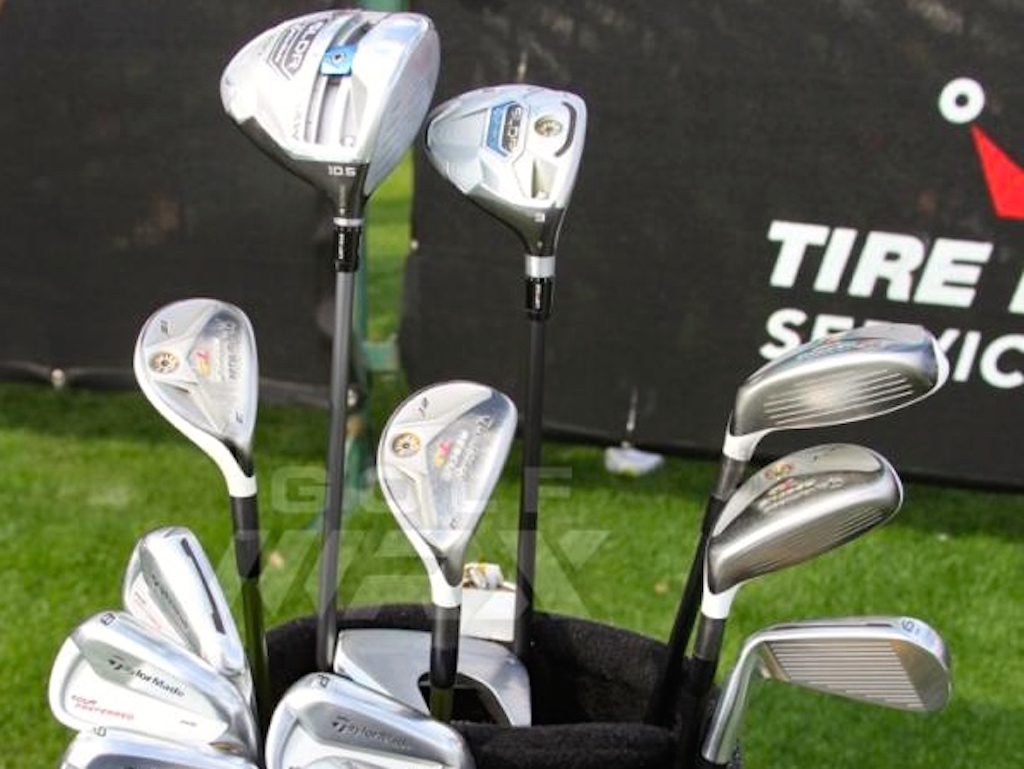
Well, the time has come for me to admit that I’m NO longer a long-iron carrying player. I’m a hybrid convert! And I’m not ashamed to admit it, because hybrids help me play better.
My approach shots with my hybrids (which replace my 2, 3 and 4 irons), fly higher, land softer and stop quicker. And when I do mishit these clubs, the results are much better and, more importantly, findable. My only dilemma is that my bag now looks like I have a traveling puppet-show in tow.
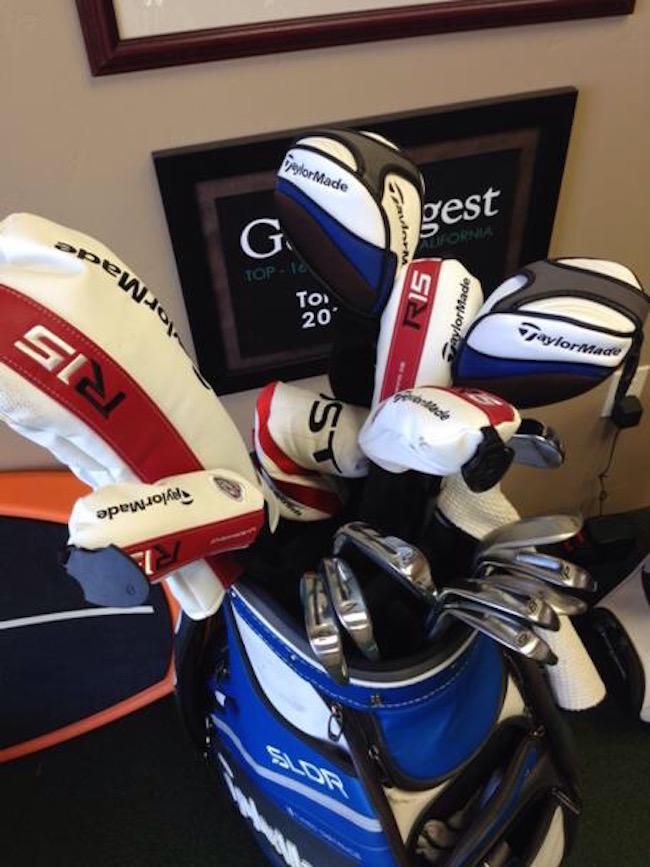
My current bag includes three hybrids!
I strongly suggest you follow my lead, and to support my suggestion here are my Top-10 reasons you need to play hybrids!
You need hybrids in the bag if you…
If your handicap is higher than 3
Higher handicap golfers must use hybrids because, generally speaking, they don’t have the club head and ball speed to use long irons effectively. Shots with long irons that don’t have ample speed will come out too low, have too little spin, and run off the back of greens. Remember that hybrids are designed to launch the ball higher, spin more, and come into the green softer; all things that the average player will find supremely beneficial.
The higher your handicap, the more fairway woods and hybrids you should have. A general rule of thumb:
- 25+ handicappers should start their iron set with a 7 iron.
- 12-25 handicappers should start their iron set with a 6 iron.
- 10 handicappers or less should start their iron set with a 5 iron.
- 5 handicappers or less should start their iron set with a 4 iron.
If you’re a flat-ball hitter
An LPGA Tour players’ average apex height with their driver is roughly 75 feet, and most amateurs never even get close to that height! I would say that most of my average players hit their long irons in the 45-60-foot range, with landing angles in the 20s and 30s. At that height, golfers simply do not hit the ball high enough to hold the green, which leads to hitting less greens in regulation.
If your misses tend to be thin and right with long irons
The thin miss with a long iron comes from the player trying to lift the ball into the air, causing the hands to flip prematurely. This moves the low point of the swing too far behind the ball, and in an effort to avoid pounding the club into the ground, the player catches the ball thin.
There’s three reason why hybrids help to eliminate this miss:
- The center of gravity is farther back and lower, which helps lift the ball into the air.
- They’re less intimidating. Golfers know, from experience, how much easier and more forgiving higher-lofted woods and hybrids are to hit up into the air, which instills confidence.
- Vertical gear effect, will help increase spin on shots hit low on the face.
If you’ve noticed your club head speed lagging over the last few years
While losing a little swing speed isn’t earth shattering, hybrids will be more convenient as your speed decreases. The slower your swing speed, the less ball speed you can achieve, and the flatter the ball will launch; all bad things if you need to stop the ball on the green. Most of the time, and especially in this circumstance, adding height increases distance.
If the course you play has mostly elevated greens
Whenever you’re hitting into an elevated green, your ball is naturally coming in flatter due to the rise of the slope and the reduced decent time of the golf ball from its apex. Therefore, a golf ball coming in higher will help offset the negative effects of the slope on your approach, and the ball stop quicker on the green. Hybrids offer that solution.
If your long irons tend to chase off the back of the green after landing
Whenever you have a lack of speed, a lack of apex height and a lack of spin, you will have a flatter launch angle and thus, a flatter angle of descent into the green. Why would you want your longer irons chasing? Hybrids will allow the ball to stop because it counters all the above factors. However, if you play in hard and windy conditions, then it might be a good idea to have the long irons handy, because if it gets too blustery, a high and spinning shot will balloon. Approach shots are all about controlling angle of descent.
If your course has tight fairways
Hybrids for the average player are easier to hit, we know, and this helps a player make better swings on more difficult driving holes. Your worst long-iron swings are almost always worse than your worst hybrid swings. Hit 1,000 shots off the tee with each, and I’ll bet you put more hybrids in play.
From a more scientific standpoint, the softer landing angle and added spin produced by a hybrid will keep the ball from running too much when it lands. Tour pros use driving irons (which are basically part long iron/part hybrid) because they have a touch more versatility than hybrids when it comes to shaping shots and changing trajectory. The tour pros don’t need the forgiveness, they need the control — but we aren’t tour pros.
If you play a “distance” ball
If you play a distance ball, chances are that you don’t have the club and ball speed necessary to spin the ball and get the ball up high enough. The carry distance between irons should have consistent separation throughout the bag. The last thing you want to see during gap testing is your shots separated by 7-12 yards in all your irons until you reach a certain length of iron, then have your carry distances close in while the run out increases. Once you start seeing the plateau, that’s where you should start adding in hybrids.
If you struggle hitting the ball solid with your irons
Hybrids can work with varying angles of attack unlike long irons — some good players are more sweepy, while others are a touch more diggy.
As discussed, hybrids are designed with this in mind: they have a wider sole, a lower and further back center of gravity, plus bulge/roll on their faces, which aids gear effect. These are all great designs that help the average player with impact and control. From a psychological standpoint, if you think something is easier to hit, you will make more relaxed golf swings. Relaxed swings are usually better, and most importantly, lead to shots that are findable!
If you want to play better
As little as I play (about 10-15 times per year if I’m lucky!), and the frequency of my practice time (zero), I need all the help I can get. Hybrids do this for me — they make it easier for me to find my shot around the green, not off in the rocks or desert.
I need something that does not require me to hit a million practice shots in order to have some idea where the ball is going to land — not to mention the fact that I just don’t hit long irons high enough for them to be useful under typical playing conditions. I am very honest about my abilities and Trackman has shown me what weaknesses I have. Why fight it when there are clubs that can help?
Golf is hard enough without letting our egos get in the way!
Related: The Best Hybrids of 2015


Club Junkie
Tour Edge Exotics mini driver review + TaylorMade Spider ZT Max first look – Club Junkie

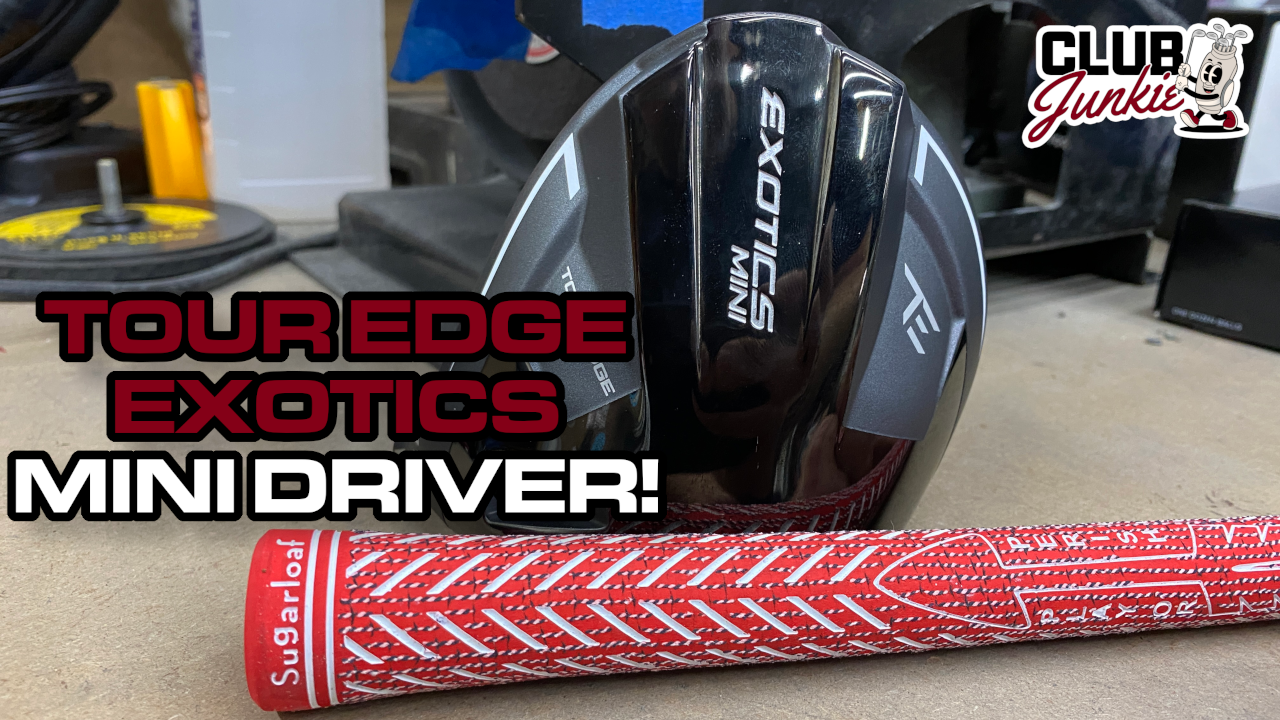
On this episode of Club Junkie, I put the new Tour Edge Exotics Mini Driver to the test and break down the performance, forgiveness, distance, and where it fits compared to a traditional driver or strong fairway wood. If you have been curious about adding a mini driver to the bag, this one is worth a look.
I also dive into the new TaylorMade Spider ZT Max putter that was recently spotted and discuss the growing zero torque putter trend. Plus, there is a closer look at the new Project X Titan Yellow shaft showing up on the PGA Tour and what makes it different from other profiles currently out there.
Opinion & Analysis
AVL: We’re talking about practice! My best tips for taking your game to the course

With the beginning of June on the horizon and courses rounding into peak condition for the season, it’s time to hone the finer skills that often get rusty over the winter. More sunlight also means more time to get out on the course and work on your game.
Whether it’s the practice green or the driving range, there’s always something to improve—whether you’re enjoying the fresh air or preparing for a weekend game or tournament. You can work on drills or freestyle around the green, and friendly competition is a great way to sharpen your skills.
While there are endless ways to get better at golf, I’m going to focus on practicing around the green. Let’s take a look at a few things to keep in mind as we head into the summer months.
Drills
From the driving range to the practice green, it’s important to incorporate drills into your routine. Years ago, I spent a weekend working on my short game with James Sieckmann. He recommended doing drill work for 5–10 minutes, then returning to your main practice.
This way, you create a balance between structured drills and real-world scenarios, so you’re not confined to “perfect” situations. For example, hitting the same three-foot putt over and over is good for repetition, but after a while, it becomes less interactive for your brain.
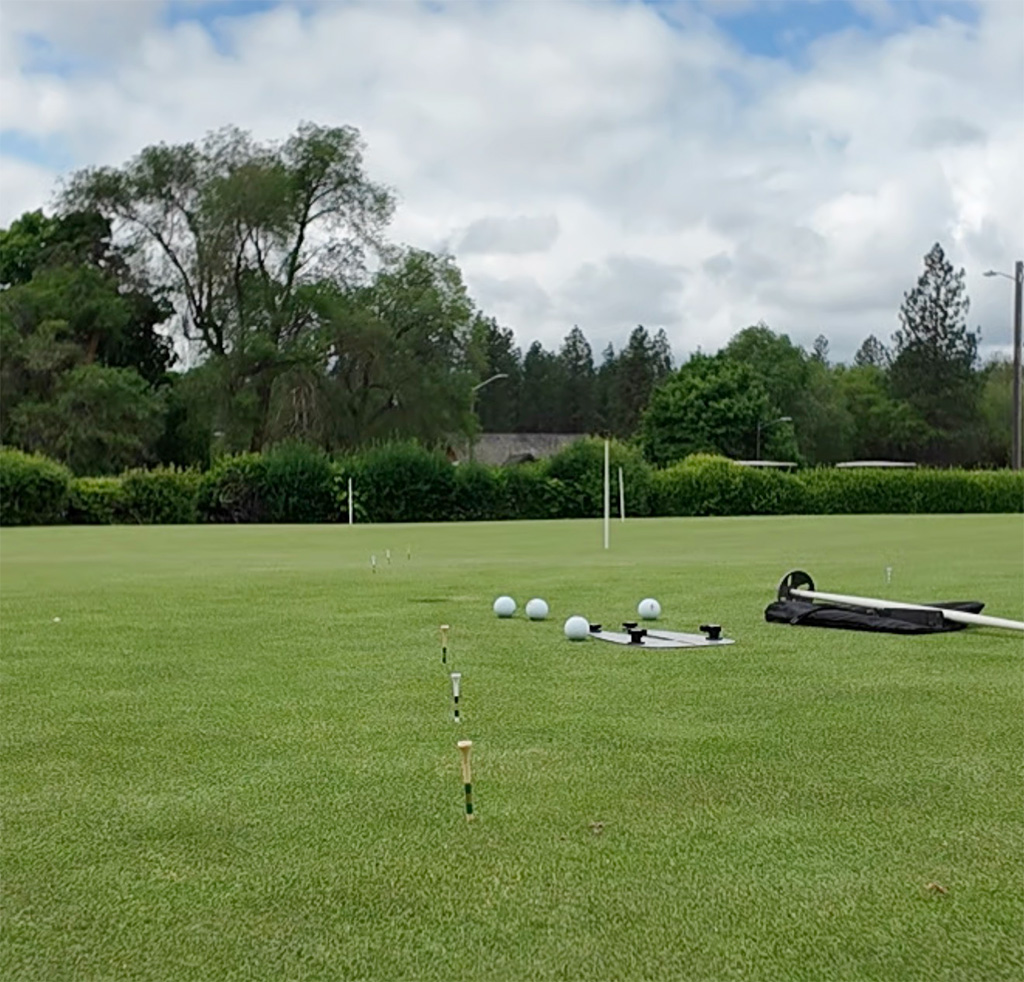
My approach is to use a putting trainer with a narrow gate for the ball to pass through, or simply place tees just outside the width of the ball. I’ll hit a series of four putts through the gate for three sets. Then, from a similar distance, I’ll hit four putts without the training aid and repeat that sequence three times.
Next, I’ll hit a number of 15–25 foot putts in a random fashion, then circle back to repeat the short putt drills with and without the training aid.
This breaks up the rhythm of hitting short putts with the training aid. When you hit the same short putts over and over, it’s easy to get into a groove—which is great for the drill, but not reflective of actual course play. While finding a rhythm is fundamental for drills, I like to introduce variation with longer putts to keep things realistic.
Game Mode
Once you’ve established a foundation with drills, it’s time to simulate on-course scenarios. This is where a few practice games come in handy.
One that I’ve been enjoying lately involves putting 10- to 15-footers with two balls. If I make the putt, great! If I miss, I pull the missed ball back a putter length. Suddenly, that little tap-in becomes a nerve-wracking three-footer—at least at first. As you get better at this game, those three- and five-footers become much more comfortable and routine.
It may sound cliché, but each shot is just what it is—it’s how we react that makes the difference. I like this game because it blends the pressure of on-course putting with the consequence of leaving yourself a much longer putt than usual.
Another game I like is one I recently learned from Brad Faxon. Place three tees in a line at four different locations around the hole: one at 3 feet, one at 6 feet, and one at 8 feet. The 3- and 6-foot putts count as par, and the 8-footer is for birdie.
This game keeps you focused on scoring and helps you get into a competitive mindset. You can even think about this putting game while you’re on the course. I just started playing it, and last week I couldn’t get better than two under par.
Competition
Competition during practice is when drills and games come to life, and you start to see results. For me, nothing beats a putting contest with a friend or two. In the right setting, these contests can become talking points for the whole season.
Match play, a game of 21, or simply seeing who can make the most one-putts (with a small prize on the line) are all great ways to simulate real on-course pressure. Recently, I played in a putting contest where one competitor made back-to-back 30- and 50-foot putts. As they say, expect your opponent to make every putt—and he nearly did. That’s impressive, and it’s something you see on the course, too: you have to stay committed to your game plan, no matter what.
When it comes to practice, it’s important to blend feedback from recent rounds with the fundamentals you want to reinforce. Drills, games, and competition—from the driving range to the putting green—form the backbone of skills you’ll rely on during actual rounds.
Finding the right balance is something we’re all working on, one practice session at a time. With the beginning of June on the horizon and courses rounding into peak condition for the season, it’s time to hone the finer skills that often get rusty over the winter. More sunlight also means more time to get out on the course and work on your game. Whether it’s the practice green or the driving range, there’s always something to improve—whether you’re enjoying the fresh air or preparing for a weekend game or tournament. You can work on drills or freestyle around the green, and friendly competition is a great way to sharpen your skills. While there are endless ways to get better at golf, I’m going to focus on practicing around the green. Let’s take a look at a few things to keep in mind as we head into the summer months.
Drills
From the driving range to the practice green, it’s important to incorporate drills into your routine. Years ago, I spent a weekend working on my short game with James Sieckmann. He recommended doing drill work for 5–10 minutes, then returning to your main practice. This way, you create a balance between structured drills and real-world scenarios, so you’re not confined to “perfect” situations. For example, hitting the same three-foot putt over and over is good for repetition, but after a while, it becomes less interactive for your brain.
My approach is to use a putting trainer with a narrow gate for the ball to pass through, or simply place tees just outside the width of the ball. I’ll hit a series of four putts through the gate for three sets. Then, from a similar distance, I’ll hit four putts without the training aid and repeat that sequence three times. Next, I’ll hit a number of 15–25 foot putts in a random fashion, then circle back to repeat the short putt drills with and without the training aid.
This breaks up the rhythm of hitting short putts with the training aid. When you hit the same short putts over and over, it’s easy to get into a groove—which is great for the drill, but not reflective of actual course play. While finding a rhythm is fundamental for drills, I like to introduce variation with longer putts to keep things realistic.
Game Mode
Once you’ve established a foundation with drills, it’s time to simulate on-course scenarios. This is where a few practice games come in handy. One that I’ve been enjoying lately involves putting 10- to 15-footers with two balls. If I make the putt, great! If I miss, I pull the missed ball back a putter length.
Suddenly, that little tap-in becomes a nerve-wracking three-footer—at least at first. As you get better at this game, those three- and five-footers become much more comfortable and routine. It may sound cliché, but each shot is just what it is—it’s how we react that makes the difference. I like this game because it blends the pressure of on-course putting with the consequence of leaving yourself a much longer putt than usual.
Another game I like is one I recently learned from Brad Faxon. Place three tees in a line at four different locations around the hole: one at 3 feet, one at 6 feet, and one at 8 feet. The 3- and 6-foot putts count as par, and the 8-footer is for birdie.
This game keeps you focused on scoring and helps you get into a competitive mindset. You can even think about this putting game while you’re on the course. I just started playing it, and last week I couldn’t get better than two under par.
Competition
Competition during practice is when drills and games come to life, and you start to see results. For me, nothing beats a putting contest with a friend or two. In the right setting, these contests can become talking points for the whole season. Match play, a game of 21, or simply seeing who can make the most one-putts (with a small prize on the line) are all great ways to simulate real on-course pressure. Recently, I played in a putting contest where one competitor made back-to-back 30- and 50-foot putts. As they say, expect your opponent to make every putt—and he nearly did. That’s impressive, and it’s something you see on the course, too: you have to stay committed to your game plan, no matter what.
When it comes to practice, it’s important to blend feedback from recent rounds with the fundamentals you want to reinforce. Drills, games, and competition—from the driving range to the putting green—form the backbone of skills you’ll rely on during actual rounds. Finding the right balance is something we’re all working on, one practice session at a time.


For Korean golfers, we always look forward to the last of the kkot-saem-chu-I for the true start of a new golf season. The term refers to a cold snap, but literally translates as “winter being jealous of the flowers beginning to bloom, thus lashing out one final time before surrendering to spring”.
A rather poetic mouthful packed into a short expression.
Koreans can be like that. Understated, yet oddly expressive at the same time. And nowhere is this more true on the golf course and in our golf bags. In fact, I suspect many Korean golfers look forward to new apparel and accessory drops more than they do actual equipment launches each year.

At this point, Korean golf fashion may exist on its own timeline. (courtesy of @seonbi_golfer)
There is ample evidence to support that suspicion. Korea is the world’s third-largest golf market behind the United States and Japan, yet its appetite for golf apparel exceeds that of both countries combined. Recent estimates suggest that Korea accounts for nearly 40 percent of the global golf apparel market, placing it among the world’s most influential golf fashion markets and punching well above its size.
Simply, we care deeply about how new golf clubs look and feel, but enjoy looking good while swinging them even more.
Golfers in the West may laugh and say that golf is played on a course, not a fashion runway. Perhaps. But what’s the harm in trying to look and feel good, if the added self-confidence can help actual performance? It certainly seems to have worked for Jason Day, who may have unlocked a new stats category: dormant strokes gained. Coincidence?

During the COVID-era, estimates placed the market near $9 billion, an astonishing figure for a single country.
As a proud member of Gen X, I’ve witnessed the highs and lows of golf fashion firsthand. The pleated trousers and wing-tipped shoes of Jack Nicklaus, the stylish plus-fours and knickers of Payne Stewart, the baggy black trousers and fitted mock-necks of Tiger Woods, and the thigh-hugging athletic tailoring of Rory McIlroy. Golf fashion, like the golf swing itself, has rarely stood still.
But nowhere have those trends shifted, evolved, and been scrutinized quite as relentlessly as in Korea. Here, golf fashion moves faster than fairway gossip, and consumers dissect brands with a level of discernment that can be both impressive and mildly terrifying. New brands are studied, judged, embraced, or dismissed with startling efficiency.
The result is a consumer base with one of the sharpest eyes for quality and authenticity anywhere in the world. It is difficult to quantify, but easy to recognize. Clean lines without trying too hard. Luxury mixed with utility. Trend awareness balanced by restraint and purpose.
It’s golf fashion shaped by one of the world’s most style-literate cities, something I like to call Seoul Sensibilities, referring to the taste level forged by a uniquely competitive environment.
And increasingly, global brands have noticed.

Many golf brands in Korea have their own flagship shops dedicated to apparel only
Titleist understood this years ago, when its apparel business in Korea took on a life of its own under new ownership and local direction. What had once been a straightforward extension of an iconic equipment giant became something sharper and more premium. By going all in on the serious Tour-player look (I couldn’t even fit into their XL sizes), Titleist struck the right chord with Korean consumers and helped its fledgling apparel business break into the mainstream. Titleist became a household name even for non-golfers who wore its caps, shirts, and windbreakers in daily life. In many ways, it proved that even heritage golf brands could carry real fashion credibility when viewed through a Korean lens.
Several years later, PXG took a page out of Titleist’s playbook and followed suit. Korean consumers helped transform the brand from one known largely for irons and loud commercials into something broader and more stylish. PXG apparel’s growth in Korea was explosive, where it found an early audience and turned the category into something more than mere logo merchandise. It is still hard to walk anywhere in Seoul without seeing its palindrome logo.
Malbon’s meteoric rise in the United States was genuine, but its ascent into a global golf lifestyle brand owes much to Korea, where it was elevated by a market already fluent in modern golf style. Korea did not simply embrace Malbon. It pressure-tested the concept, refined its appeal, and helped push it into the global spotlight.
As such, new brands may arrive from abroad, but more often than not, their sharpest evolution happens here. If a brand can earn credibility in Seoul, it’s deemed to have passed one of the toughest style audits in the game.
That is why the next meaningful chapter may not come from outside, but from a Korean brand moving in the opposite direction, carrying those Seoul Sensibilities outward as K-pop once did.

Play young Stay dope.
From Seoul, With Intent
Khalhon is a label that feels less like a trend-chasing newcomer and more like the product of a market that has already seen everything. Golfers here have long been surrounded by luxury logos, technical fabrics, and tour uniforms disguised as lifestyle wear and vice-versa. In other words, novelty alone rarely lasts here, and the Koreans seems to understand that instinctively.
Its style language leans into clean silhouettes, relaxed but tailored proportions, muted palettes, and premium materials that speak quietly but confidently. There is a modern city aesthetic running through it all, with strong layering pieces, thoughtful textures, and subtle branding that suggests sophistication rather than demanding attention.

“Built for the course. Designed beyond it.”
Most importantly, the garments seem designed to blur the line between golfwear and everyday style. Shirts, trousers, knitwear, and outer layers move comfortably between a game of screen golf, a lunch reservation, an airport gate, or an afternoon coffee in Gangnam with friends.
It raises the question of whether this is golfwear that happens to look good off the course, or everyday clothing that performs beautifully on the fairways.
Personally, I have long appreciated Nike Golf for its clean, athletic modernization of golf attire. It also has the useful side effect of making me look like a more serious golfer than I probably am. But off the course, there are times when being instantly identified as the golf guy in a crowd of non-golfers can feel a touch self-conscious.

“Built for the course. Designed beyond it.”
That is part of what drew me to Khalhon, which seemed to blend golf and everyday wear naturally. While some of the outfits may be slightly beyond my personal confidence level, the brand also offers tasteful options for older guys like me who still want to express a little personality without regretting the decision later.
These are not simply flashy outfits worn on the course and then banished to the closet until the next tee time. They work surprisingly well off the course too, and I suspect many of the pieces will still look right a couple of years from now, which would certainly be kinder to my wallet than most golf fashion trends tend to be.
And perhaps that broader lifestyle positioning also helps explain why someone like Sean Wotherspoon would find Khalhon creatively interesting in the first place.

“Built for the course. Designed beyond it.”
“Korea is not only one of the most fashion-forward golf markets in the world, but one of the most fashion-forward markets globally. Korea is ahead, and I love to watch and try to catch up.” – Sean Wotherspoon, Creative Director at Khalhon
Seoul and Beyond
If Khalhon’s rise says something about where Korean golf fashion is today, its relationship with Sean Wotherspoon says even more about where it is heading.
For readers less familiar with Sean Wotherspoon, his arrival at Khalhon is not some routine celebrity endorsement or influencer collaboration. In design and streetwear circles, Wotherspoon is regarded as one of the more influential creative voices of his generation, particularly when it comes to blending nostalgia, storytelling, and contemporary culture into products that people can connect with.
He first gained widespread attention through his now-famous Nike sneaker collaborations, where his vintage-inspired designs and instinct for color helped turn him into one of the defining artists of the late-2010s sneaker era. His work gradually expanded beyond footwear into apparel, automotive collaborations, collectibles, and broader lifestyle design.
Modern golf style now extends well beyond the fairways, where performance and functionality are largely expected by default. And while plenty of brands already make technically competent golfwear, Khalhon seems more focused on designing clothes people would genuinely want to wear even after the round ends.
And when guys at Wotherspoon’s level show genuine interest in working with a Korean golf brand as its new Creative Director, fashion circles tend to sit up and pay attention. There’s already a huge buzz among the fashion-conscious here about upcoming collabs with iconic sports stars and brands.

“My creative direction for Khalhon is disruptive, colorful, nostalgic, and modern. My goal is to blend these avenues seamlessly within each collection.” – Sean Wotherspoon
In chatting with Sean, what stood out most to me was how genuinely energized he sounded about the project itself. Despite having already worked across and countless other creative spaces, he described golf as a completely fresh category for him, saying that Khalhon “will be an amazing vehicle for my design work.”
At the same time, his enthusiasm seemed tied just as much to Korea itself. He spoke openly about admiring Korea’s fashion culture while repeatedly insisting he is still a terrible golfer.
There was something oddly refreshing about that humility. Rather than sounding like a celebrity parachuting into golf simply because the category suddenly became fashionable, Sean sounded genuinely curious about what Korea might do with the category next.
And perhaps that is what makes Khalhon feel interesting right now. The brand feels less like a trend-chaser and more like the natural result of a market now confident enough to export its own point of view.
For years, global brands came to Korea to sharpen their image against one of the most discerning audiences anywhere. Now, a Korean label appears ready to send those Seoul Sensibilities outward instead.
Which brings us back to kkot-saem-chu-i.
That final cold snap before spring always arrives with a reminder that seasons are changing, whether we notice it immediately or not. Golf fashion feels a little like that right now as well, as the old boundaries between sport, streetwear, luxury, and everyday style continue to soften.
And somewhere in Seoul, a Korean golf label already seems prepared for whatever season comes next. I just hope they have everything in my size.

Aaron Rai’s winning WITB: 2026 PGA Championship

Russell Henley’s winning WITB: 2026 Charles Schwab Challenge

Photos from the 2026 CJ Cup Byron Nelson

CJ Cup Byron Nelson Tour Report: Koepka and Kim’s newest putters finally get hot

Charles Schwab Challenge Tour Report: MacIntyre, Åberg and Spaun all switch putters, TaylorMade launches new Spider

Details on J.J. Spaun’s surprise putter switch

GolfWRX Launch Report: 2026 Titleist GTS drivers

Photos from the 2026 Charles Schwab Challenge

PGA Championship Tour Report: Fitzpatrick, Koepka among big-name putter switches for Aronimink

Photos from the ShopRite LPGA


Maria Torres WITB 2026 (June)
Driver: Ping G440 LST (9 degrees) Shaft: Accra TourZ Green 5-M4 3-wood: Ping G440 Max (15 degrees) Shaft: Accra TourZ Green 6-M4 5-wood: Ping G440...


Eric Cole WITB 2026 (June)
Driver: PXG Lightning Tour Max (9 degrees) Shaft: Project X Titan Yellow 70 TX 3-wood: TaylorMade Qi4D (15 degrees) Shaft:...


Si Woo Kim WITB 2026 (May)
Driver: Callaway Quantum Triple Diamond (8.5 degrees) Shaft: Fujikura Ventus Black 6 X Mini driver: Callaway Paradym Ai Smoke Mini...


Wyndham Clark’s winning WITB: 2026 CJ Cup Byron Nelson
Driver: TaylorMade Qi4D (10.5 degrees) Shaft: Project X Titan Yellow 60 TX 3-wood: TaylorMade Qi4D Tour (15 degrees) Shaft: Project...


Notto
May 15, 2026 at 9:51 am
Currently the only thing in my bag that is not a wood or hybrid is my 56 sand wedge. Playing better than ever.
Pingback: Best Golf Clubs For Beginners [Updated for 2020] | HittingTheGreen.com
Don Golfo 2018
Oct 15, 2018 at 2:07 am
There is a lot of bravado going on here in the comments. The question is not can you hit a 3 iron well. Really it’s can you hit it as consistently as an equivalent hybrid. I’ve seen lots of amateurs hit great 3 iron shots on one hole and then see a big drop off on the next hole. I think that if they swallowed their pride they’d find that the poor strikes with a hybrid would have been far less damaging. I know a lot of guys will be reading this thinking I don’t make bad strikes, but that’s just delusional.
Travis
Jun 6, 2017 at 3:55 pm
I love all the comments here about people saying “learn to hit long irons” when the vast majority of Tour Pros nowadays are going to easier-to-hit long clubs. Look in the bag of even the best in the game and you’ll see a hybrid of some sort in the 3-iron/21*-ish spot. Numerous pros don’t even start their true iron sets until the 4 or 5 irons. They’re all using hybrid clubs in the long irons now. Some are chunky “driving irons”, some are hybrids, but whichever way you spin it, they are all hybrid clubs to some variety whether they be more iron-like or wood-like.
If the best players in the world are going for easier to hit alternatives of their 3 and 4 irons, and starting their real irons at the 5-iron, then I think a lot of us should take notice.
Rick
Nov 9, 2016 at 6:36 am
I have only been playing golf since I retired (5 years) and I was advised to get rid of my 3 and 4 irons and use a hybrid. I believe I have been using it reasonably successfully for the last two years (despite criticism from mates who have been playing for the last 40 years), to drive the last 150 metres to the green, chip the ball onto the green from 15 metres out etc. It has proven to have been an invaluable club and I get a bit pissed off when people tell me I should be using an 8 or 9 iron onto the green, and I should use anything but my hybrid! I think it is time they moved on and started to get with the modern game.
I believe there is more skill in using a hybrid from various distances than supposedly using a 7, 8,or 9 iron as the occasion calls!
Each to his own I guess!
Rick
Richard
May 14, 2015 at 11:24 am
The handicap analysis at number 10 is absolute baloney. It is all about strike and not your handicap. I play off 16 and according to flightscope and trackman, I get far better numbers off long irons than I do a hybrids. It comes down to whichever you happen to strike better and ultimately what you prefer looking down on. There is no general rule of thumb in golf just people trying to cover their backsides…..
Nard_S
May 6, 2015 at 9:52 pm
I’ve adopted an alternative perspective. Learn how to hit a long iron and every club in your bag becomes easier to hit. 3-irons off the tee are a higher percentage shot than any wood or hybrid once you dedicate.
Phat
May 6, 2015 at 5:09 pm
Cheers Tom. I play a similar about to you so it was also time to get realistic about what I can actually hit consistently. Favorite clubs in my bag the past two years have been an s300 shafted 585h 21* followed by my old Aussie blade PW. Recently added a 24* hybrid. These two hybrids are definite performers for me both on 150+ yard par 3s and par 5 fairways. Problem clubs for me are fairway woods (removed from my bag recently), low lofted drivers (read. gave away my 9.5 and shortened my 910d to 44″ and set to 13* draw – much more consistent and even drove the green on a par 4 last week…) as well as hot faced perimeter weighted shorted irons (hit my 25 year old Hogan Redline 7-E more consistently than anything out there. There is a lot to be said for idiosyncratic club set ups and seems strange that there aren’t more unusual PGA WITBs.
Bigleftygolfer
May 6, 2015 at 10:18 am
So any advice for a low handicapper who is getting older really wants to use a hybrid for his three iron but just can’t seem to find one I can hit consistently? I currently play miura Tournament blades I hit them fine unless my knee hurts and sway and end up hitting a pull however aside from old age I have a higher ss 115 with driver. Does anybody have a suggestion for a lower HC HYBRID every time I try a HYBRID I hit a balloon ball And I can’t seem to flight them at all my 3 iron goes high and lands soft but I no longer hit it over 225 so I have learned from fellow players that hybrids go a bit further than a normal blade. I have seen this on trackman but can’t find a head that suits my eye or playing needs I typically play local state events and private clubs that usually have greens in the 10 -12 range I also play in all conditions so ability to flight and shape the ball is important to me. Please help as I have swallowed my ego years ago but can’t find the right club!
Dave S
May 6, 2015 at 1:31 pm
I would try the Adams Pro A12 (from a few years ago) for a few of reasons: (1) They are a smaller-headed hybrid that will probably be a better transition from iron to hybrid for a low handicapper, (2) because they are geared toward the better player, they have very little off-set (which means you’ll have an easier time converting to them using your standard long iron swing, (3) they come with very good stock shaft offerings (Aldila RIP Phenom or Matrix Ozik White Tie), and (4) You can get them for very cheap now (b/w $40 and $80 on ebay)… don’t get sucked into buying the new version that’s $180. I game the 20deg to replace my 3i and an Adams DHY 24deg to replace my 4i. Loving them. Cheers!
MHendon
May 6, 2015 at 5:40 pm
Yeah I use the 20 degree A12 also but to replace my 2 iron. And I bought a 22 degree tour issue Adams Pro black head and had the same shaft as the 20 degree installed in it. The Matrix shaft. The pro black has a very small head and actually feels like an iron. Flights the ball like an iron but longer and more forgiving. It’s great out of difficult lie’s and even for chipping around the green.
Phat
May 6, 2015 at 5:23 pm
Could be worth trying a stiff, steel shafted 21* hybrid… I picked up a very well used titleist 585h 21* (shafted with an s300) a couple years ago for $20. It plays so well that I professionally refinished the chipped paint on it head and now bag it for every round. Can’t imagine a more consistent 3i substitute.
Obee
May 20, 2015 at 10:19 pm
Absolutely. As a low-handicapper myself (0 to +2 during the season, usually) who plays a LOT of hybrids (my longest iron is an 8-iron!), the key for better players who want to use hybrids is that the shaft should be heavy (75 or more grams) and should have minimal torque (3 degrees or less?). Find a hybrid shape that you like and put a heavier, stouter shaft in it, and I’ll bet you fall in love. 🙂
Jeffrey
May 6, 2015 at 3:54 am
What if you do not like the look of Hybrids? (like Me) and therefore have never had them and never will. I will stick to my Fairway woods and long irons regardless of handicap.
dapadre
May 6, 2015 at 5:28 am
Have you tried Hybrid irons.
Dave S
May 6, 2015 at 1:34 pm
Incredible clubs… game the Adams DHY Proto XTD from last season in 24deg as a 4i replacement and I absolutely love it. They are miles more forgiving on mishits. I’m not joking that I hit the club 200 yds on the nose out of the first cut of rough, uphill (walked this off with GPS)… I would have never come close to that w/ my old 4i. Everyone but low single digit HCPs would benefit from these clubs.
Alex
May 5, 2015 at 1:54 pm
Long irons are SO MUCH EASIER to control in the wind. If there’s a 10+ MPH wind in my face, putting a hybrid club in my hands is like suicide. I like having the two extremes of a long iron (3) and also carrying a 7 wood. They’re the same loft, but are useful in two completely different situations.
Graham
May 5, 2015 at 3:32 am
Can we please put aside the arbitrary “if your handicap is…” rules when they have zero relevance to the topic at hand? So people above a handicap over 3 should carry hybrids because they generally don’t have the clubhead and ball speed to use long irons effectively? Why not then just say “if your average driver clubhead speed is not 105” or something that actually pertains to the topic at hand? Sorry to rant, but as a high handicap (12) with high clubhead speed (avg ~110) these blanket statements that somehow magically relate clubhead speed and ball-striking to handicap are just plain wrong. Over 60% of the shots on a golf course are taken inside 100 yards, and it’s those shots that prevent some of us from reaching your magical arbitrary 3-handicap , not the fact that we do or don’t carry hybrids…
Carlos Danger
May 5, 2015 at 10:24 am
While I agree with the overall message of this article in that 95% of golfers have no business with anything higher than a 5 iron in their bag and if they took the time to practice with a hybrid they would have better results.
I do agree with your comment regarding the blanket statements about what you should play based on your hdcp. Im a 5 and If you were to watch me hit the ball off the tee and out of the fairways…you would think I was tour player. I have just always had a really good swing and been a good ball striker, but like most people…my weak point is on and around the greens. There are many guys that I lose to that I crush it past and hit it alot better than that make up so many strokes on the green. So if you want to say anyone over XYZ hdcp need to play this…that is not accurate.
I think the further breakdowns in this article regarding your average miss, ball flight, club head speed, etc…are much better indicators
Joe Golfer
May 6, 2015 at 12:06 am
Excellent point about the relationship to handicap and the need for hybrids.
I happen to hit the ball fairly well with five iron on up, but like you I lose strokes on the short game due to lack of available practice time and facilities.
One problem I don’t have with my hybrids is ballooning. That may be because my hybrids are rather old. They are Sonartec MD hybrids, probably the first company to popularize the hybrid. It still gives a penetrating ball flight, but it is much easier to hit than a three or four iron.
That said, they don’t stop as fast as some of the current hybrids that give a much higher ball flight, but I’ll take the happy medium.
TR1PTIK
May 19, 2015 at 8:53 am
Absolutely agree with the sentiment here. I play off an 18 handicap with an average swing speed of 102 – 105 (according to my most recent lesson with Flightscope). I can play from pretty much any tee on the courses near me (they’re all quite short) and score roughly the same. I lose it all in penalties (usually OB from slicing my driver) and the short game.
Travis
May 5, 2015 at 3:18 am
This article is spot on.
I replaced all irons 3-6 with Cobra hybrids. I have noticed very good results as Im not long off the tee. Even if my 2nd shot is 170m out I can hit the green about 1/3 of the time and if I miss have a short chip.
Before anything +160m and I would completely botch the shot maybe 1/3 of the time. Have to play the percentages. 3iron vs 3 hybrid not question what is easier to hit – for me
Greg
May 4, 2015 at 9:31 pm
I picked up a Mizuno JPX Fli-Hi Hybrid #4. Its a long iron replacement so it fits right in to replace that iron…same length. Its not longer like a normal hybrid. Mine fits right into my G25 irons set. It’s 1/2″ shorter and a 2* flat lie. So you can customize them. It is soooooo much easier to hit than a typical 4 iron. It’s so much easier for me to hit that I just ordered a #5. I have one regular hybrid and its a 20* Ping G20. Easily the easiest and most consistant hybrid I’ve ever hit. These clubs aren’t leaving my bag. Seriously…..if you’re considering switching out a 3, 4, or 5 iron for a hybrid check into the Mizuno JPX Fli-Hi’s. They’ll change your golfing life 🙂
Pablo
May 4, 2015 at 8:20 pm
I can hit a 3 wood 250 yards, I pee standing up, and I play a hybrid. Michelle Wie — US Women’s Open champion — pees sitting down, drives the ball further than most members of GolfWRX (even though everyone here drives it over 300 each time lol), and she uses hybrids as well.
Oh, the plight of the macho man and his fragile sensibilities! Lol
MHendon
May 6, 2015 at 5:43 pm
LOL I’m with you Pablo
Tweedie
May 6, 2015 at 9:27 pm
Given the way she bends over while putting, I wouldn’t like to guess how she pees!
Philip
May 4, 2015 at 6:14 pm
Personally, whenever I suck at my long irons, I suck at hybrids; and when I smoke my hybrid, I smoke my long irons. Thus, I’ll continue to improve my swing and game overall instead. I still have one 20 hybrid and am looking for a 23/24, but I do not find any real differences between irons and hybrids, for myself – they play the same.
Jack
May 6, 2015 at 12:21 am
The main benefit for me is that for the same hybrid club that replaced an iron, I can swing easier knowing that it will fly just as far. That’s a huge plus already. Unfortunately I feel like my missing with hybrids are worse than my irons. I didn’t actually test that but it just feels like it.
Philip
May 11, 2015 at 2:29 pm
That’s the thing. For sure the average person “me included” can get a ball airborne with less effort using a hybrid, but my it is the misses that causes me the most grief. I suspect by the time I am able to rock a long iron, my hybrid will become steady too. At least I hope so. Personally I enjoy my hybrid more for the saves I can pull off with it over just a long iron replacement. Around the green, in the sand, in the woods – you name it – I find so many creative uses for a hybrid. I may even pull a wedge to keep my 3i and use my hybrid mainly for emergency recovery situations.
Mr. K
May 4, 2015 at 6:09 pm
There should be an asterisk next to this article, applies to a few. You don’t need hybrids, if you hit them well then sure by all means. But it’s not the end all be all that it’s portrayed to be.
MHendon
May 4, 2015 at 5:46 pm
I think one point you left out Tom is the very low spin rates of the new golf balls. I’m 45 now and my club head speed is still with in a mile and hour or two of when I was 30. Back then I not only carried a 3 iron but also a 2. The higher spin of the ball 15 years ago allowed it to climb easier off that low launch angle you get with long irons. Not long after the introduction of the PROV1 I replaced my 2 iron with an 18 degree adams hybrid. About 3 years ago I realized the carry difference between my 3 and 4 iron was only about 7 to 8 yards so I replaced the 3 iron with a 22 degree adams hybrid. Now my gaping is much better. Just for sake of reference I’ve been using the same Irons since 2001 Mizuno MP33’s and my club head speed usually comes in around 112. Oh and I’m a 1.6 handicap and feel know shame in carrying two hybrids because not only are they better from good lies, they’re far superior from bad ones.
SJ
May 6, 2015 at 8:47 am
+1
Cliff
May 7, 2015 at 10:15 am
+2….great out of the rough and fairway bunkers!
Jang Hyung-sun
May 4, 2015 at 5:03 pm
I don’t like hybrid Traj. For me, nothing like hitting my Miura MB-001 3 iron…butter soft. Anything longer its PRGR fairways paired with Oban Devotion- so easy it’s automatic. Once I no longer hit Miura 3 iron perfectly I put on skirt rather than hit pickle on stick looking hybrid.
Cliff
May 7, 2015 at 10:18 am
I’ll take my hybrid from the thick rough over your Miura 3i any day of the week.
Martin
May 4, 2015 at 4:39 pm
4/10 apply to me, I gave up on my 3&4 irons over 10 years ago.
I used to love hitting my 3 iron, but reality is even when my Driver SS was 102-105 (now low 90’s), hybrids were just so much easier to hit higher and straighter.
Lowell
May 4, 2015 at 4:24 pm
Totally agree with your recommendation of switching long irons for hybrids. I myself picked up a hybrid to fill in the gap between my 3 wood and 3 iron. My 3 hybrid hits about 230 and my 3 iron is right at 215. Great way to pick up yardage when needed on those longer par 3’s.
Jim
May 4, 2015 at 4:04 pm
As a PGA Teaching Professional and accomplished player, I definitely agree!!!! Best thing to happen to golf in a very long time!!! If you haven’t tried them you should. If you are “too good”” for them well I hope your ego doesn’t mind throwing a few shots (or dollars) away each round! If it’s legal and it makes it easier……why not?!?
Lucky Intervale
May 4, 2015 at 3:51 pm
I do have a 17* H2 that I hit well, but I love the idea of the hybrid iron… best of both worlds. I game an MP H5 3 iron bent to 20* with a lighter weight version of my irons’ shafts… money. Wilson’s new hybrid irons are sweet as well…
David
May 4, 2015 at 10:34 pm
Lucky, I’m on the same boat as you. I’ve tried many hybrids and no luck. Tried again over the last month and my Mizuno MP-H4 2-iron continues to win out. The heavier and SHORTER shaft definitely help me with my accuracy. But, Tom, I fully understand your position and encourage others to go the hybrid route.
sgniwder99
May 5, 2015 at 7:52 am
I’m with both of you on the H4 and H5s. I have a full set of H4s right now. But come on, let’s not fool ourselves. The H4 and H5 long irons ARE essentially hybrids.
David
May 5, 2015 at 11:12 pm
Yes, I would say they are a cross of a hybrid and an iron. Say one part fairway metal and two parts iron (if a hybrid is only one part of each). Very forgiving due to their large cavity, but steel shaft, shorter shaft, and minimal offset really benefit those with some higher swing speeds that are looking for forgivenes.
tony
May 6, 2015 at 4:35 pm
I love that as you get better, you can get player Mizuno irons and still use the MP-H4/5 series for the long irons. Pretty much like mizuno does with their split sets.
Brutus
May 4, 2015 at 3:33 pm
I hate comments like “if you’re a 3 handicap or higher”. I had 2 hybrids in my bag (21 and 25 degree) and recently starting this season put my 4 iron back in the bag over the 25 hybrid. I play to about a 9 handicap, but I was rewarded with several excellent 4i shots into the wind in the first several rounds this year that the hybrid is too unpredictable in handling. I found that distance control with hybrids in general is harder than with a iron too, even in calm condidtions. That said, the 21 hybrid is one of my favorite clubs to hit. Arbitrary rules are meant to be broken arbitrarily.
Golfraven
May 4, 2015 at 1:42 pm
btw, if you don’t like chunky hybrids try a Ping iSeries or even Adams. Ping i20 hybrid is still one of my favourites – even compared to my new 915h. If you want to go back in time, buy the Ben Hogan CFT hybrid. Had this one for over 8 years in the bag – those still sell well on ebay.
Golfraven
May 4, 2015 at 1:36 pm
What about replacing your short Fairway woods with hybrids? I have just kicked my 4 FW out and put a H2 instead in the bag – guess which of those I hit better off the deck and fairway/semi. You still see lots of folks with FWs but think they would have less work swinging a Hybrid.
Mke
May 4, 2015 at 1:13 pm
Have a 3 wood and 5 hybrid. Feel like I used to hit the hybrid better but lately been money with the wood.
jcorbran
May 4, 2015 at 8:16 pm
those are normally 4 clubs apart. 3w/1i, 5w/2h/2i, 7w/3h/3i, 9w/4h/4i, 11w/5h/5i.
Jeff Smith
May 4, 2015 at 1:11 pm
That idea doesn’t apply to everyone and most of your numbers are meaningless and not accurate
Tom D
May 4, 2015 at 12:55 pm
For the record, I pee sitting down. Easier than remembering to constantly adjust the toilet seat. I also play hybrids instead of long irons. I am quite consistent with long irons – consistently short, consistently bad. With hybrids I am inconsistent: occasionally bad, usually pretty good, once in a while brilliant. A foolish consistency is the hobgoblin of small minds.
SJ
May 6, 2015 at 8:51 am
Sitting down is just more comfortable. Why society decided we have to stand is beyond me!
MHendon
May 6, 2015 at 5:47 pm
It’s not as messy either. lol
Bob
May 4, 2015 at 12:51 pm
I hit a 21* hybrid (similar to a 3-iron) at a demo day about twelve years ago. The first three balls I hit were the best 3-iron shots I had ever hit, and all in a row. Maybe one out of three actual 3-iron shots would have flow like that, and I did that with the hybrid every time. Instant convert.
All you have to do is swing the club and stay out of its way. I even use a 17* hybrid that I hit very straight and let it eat up the yards. I can still hit my 4-iron, but the hybrid is so much less work, there’s no point in not using it.
9.5 handicap.
jcorbran
May 4, 2015 at 8:13 pm
most manufacturers have a 17* 2 hybrid, 19* 3 hybrid and a 21/22* 4hybrid, so it sounds like you were hitting the 4 hybrid better than your 3 iron, looks like a keeper as long as your gapping is good.
Charles
May 4, 2015 at 12:47 pm
Tom, great article as usual, but I have a question. What loft is a long iron for you? When I played my best in 1972-74 my iron set, Wilson Staff forged, had a 1 iron of 17* of loft, 5 iron had 32* loft, this is almost my current 8 iron. Going this way the golf club companies will release in 2020 a Pitching wedge of 36* loft.
Nolanski
May 4, 2015 at 2:07 pm
36 degree PW? Ha! Thats too funny. Eventually they will have to stop strengthening club lofts right? Its kind of insulting that golf companies think they can pull a fast one on consumers with their whole disappearing loft shenanigans.
MHendon
May 6, 2015 at 5:51 pm
That’s because most golfers are egotistical male hacks who only care how far they hit it. However it’s funny when they can hit there super strong 8 iron as far as mine but are then 50 yds behind me off the tee.
rob
May 4, 2015 at 12:37 pm
Tom, great advice, its good to hear someone of your stature finally talking sense!!! Rob
Charles
May 4, 2015 at 12:28 pm
In the end of each hole you just write a number, you don’t tell stories. It doesn’t matter if you are a super macho fueled by steroids or a delicate lady, in the end you just write a number. And just to remember the objective of the game is to score the lowest possible in accordance with the rules, it is totally independent if you pee stand up or seated.
Brian
May 4, 2015 at 12:50 pm
Yeah, but sexism!
Myron miller
May 4, 2015 at 12:14 pm
This might be good advice but i don’t believe its true for everyone. Personally I’ve tried well over 100+ hybrids and have yet to hit one consistently. One I hit pretty good but still had my usual problems with it – chunking it. Whereas my 4 iron may not be as high although its higher than many 4 hybrids I’ve hit but is way more consistent. And there is no comparison to how well I hit a 5 iron versus any hybrid – higher/longer/more consistent contact.
A couple of 4 hybrids I tried I couldn’t get over about 6-10 feet off the ground no matter what. I think the highest shot was 10 feet and many were not more than 5 feet. Granted my 4 iron is about 20-30 feet but the 5 is about 50-60. Driver is close to 100
And i’m definitely shorter and less swing speed than years ago. But I’ve gone to a 5 and a 7 wood and am looking for a 9 wood with the correct shaft. i use both the 5 and the 7 wood a lot and am very comfortable hitting them.
I think he missed the point by recommending only hybrids and not higher lofted woods. Not everyone can hit a hybrid where they could hit a fairway wood and others would definitely hit a hybrid easier than a fairway wood. It most assuredly is not a one set of hybrids fits all situation.
dapadre
May 4, 2015 at 12:10 pm
So very true! I have seen the results of this with a playing partner. He asked me for some advice as a recent golf convert. Since he had played for about 2 years he saw little improvement. I told him ditch your 3 – 6 irons and use hybrids. he was really hesitant at first, but did it. That summer he dropped from a HCP28 to 16! He is now a HCP 12 an his highest iron is a 6. What many fail to take into consideration is for one the lofts have gone wacky. Note that what you is being sold as a 5 iron now is probably a 4 or even a 3 iron not to long ago. Also for some especially newbies, they dont have the swing speed to get the long irons airborne to a good height. I can hit a 4 iron quite well, but 5 is my longest iron.
Some food for thought, most senior tour players have 5-6 as longest irons. Lydia Ko’s longest iron is a 6. She is lighting up the LPGA. For the guys that may look down on that and say LPGA or Senior, if you had an LPGA/Senior game, you would be one heck of a player.
Paul Clarke
Dec 18, 2015 at 10:30 am
Excellent comments, could not agree with you more. I run three hybrids, a 3 set at 20 a 4 set at 24 and a five set at 28 my Mizuno irons come in with a six set at 32, which by the way used to be the typical 5 iron, and 4 degree gaps all the way to 60 lob wedge. While I appreciate that removing long irons from ones bag is considered by some to be less than completely heterosexual, I find that the results speak for themselves. So I shall continue in my own little world with my 6 handicap and enjoy the game for what it is meant to be, namely, fun.
Jm
May 4, 2015 at 11:13 am
I definitely believe most players should be playing less long irons and more hybrids/fwy woods.
2 good reasons are the new balls and the new irons
The newer balls typically spin less off long irons than even the balls of 10-15 years ago. Also the new iron lofts make a 4 iron play at the same loft as previous 2/3 irons
What are your thoughts on choosing hybrids over fairway woods?
I have seen data that shows players hit hybrids better in regards to yards off line left to right (better directional control) and typically hit fwy woods better in regards to how close to pin high (more consistent distance control)
I believe some of this can be equated to shaft length differences and I believe most people would actually be better off with fairway woods that are cut to the corresponding hybrid length
Adam
May 4, 2015 at 12:19 pm
It’s interesting what you said about new balls and new irons. A lot of equipment accommodates higher handicap players so when they start to get better, different adjustments need made. If a new player needs a low spin ball to help keep the ball straight, what do they do when they have to stick balls on greens? Is that what you were getting at? I guess that wouldn’t solve the landing angle problem though.